



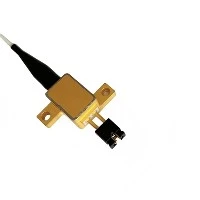
Most lasers are composed of three parts: an excitation system, a laser medium, and an optical resonator. An excitation system is a device that produces light energy, electrical energy, or chemical energy, such as a laser power supply. At present, the excitation means used mainly include illumination, electricity, or chemical reaction. Laser media are substances that can produce laser, such as rubies, neodymium glass, neon gas, semiconductors, organic dyes, etc.⑧⑨
3. Classified by mode of operation (Continued to Part 1)
⑤ mode-locked laser, this is a special type of laser using mode-locked technology, its working characteristics are determined by the phase relationship between the different longitudinal modes in the resonator, so a series of laser ultra-short pulses (pulse width 10 ~ 10 seconds) sequence can be obtained in time is equal interval, if the special fast optical switching technology is further used, A single ultrashort laser pulse can also be selected from the above pulse train (see laser mode-locking technique).
⑥Single-mode and frequency stabilized laser, single-mode laser refers to the use of a certain mode limited technology in a single transverse mode or single longitudinal mode state of operation of the laser, frequency stabilized laser refers to the use of certain automatic control measures to make the laser output wavelength or frequency stable in a certain precision range of special laser devices, in some cases, It can also be made into a special laser device with both single-mode operation and automatic frequency stability control (see laser frequency stabilization technology).
⑦In Tunable lasers, under normal circumstances, the output wavelength of the laser is fixed, but after the use of special tuning technology, the output laser wavelength of some lasers can be continuously and controllably changed within a certain range, this class of lasers is called tunable lasers (see laser tuning technology).

4. According to the different wavelength ranges of the output laser, various types of lasers can be divided into the following types.
①For far-infrared lasers, the output wavelength range is between 25 and 1000 microns, and the laser output of some molecular gas lasers and free electron lasers falls into this region.
②Middle infrared laser refers to a laser device whose output laser wavelength is in the middle infrared region (2.5 ~ 25 microns), represented by CO molecular gas laser (10.6 microns) and CO molecular gas laser (5 ~ 6 microns).
③Near-infrared lasers refer to laser devices whose output laser wavelength is in the near-infrared region (0.75 ~ 2.5 microns), represented by neodymium-doped solid-state lasers (1.06 microns), CaAs semiconductor diode lasers (about 0.8 microns) and some gas lasers.
④ Visible laser refers to a class of laser devices whose output laser wavelength is in the visible spectral region (4000 ~ 7000 angstrom or 0.4 ~ 0.7 micron). They are represented by ruby lasers (6943 angstroms), He-ne lasers (6328 angstroms), argon ion lasers (4880 angstroms, 5145 angstroms), krypton ion lasers (4762 angstroms, 5208 angstroms, 5682 angstroms, 6471 angstroms), and some tunable dye lasers.
⑤The output laser wavelength range is in the near ultraviolet spectral region (2000 ~ 4000 angstroms), represented by nitrogen molecular laser (3371 angstroms) xenon fluoride (XeF) excimer laser (3511 angstroms, 3531 angstroms), Krypton fluoride (KrF) excimer laser (2490 angstroms) and some tunable dye lasers
⑥Vacuum ultraviolet laser, its output laser wavelength range in the vacuum ultraviolet spectral region (50 ~ 2000 angstroms) is represented by (H) molecular laser (1644 ~ 1098 angstroms), xenon (Xe) excimer laser (1730 angstroms).
⑦X-ray laser refers to the output wavelength in the X-ray spectrum region (0.01 ~ 50 angstroms) laser system, soft X-ray has been successfully developed, but is still in the exploration stage.

5. Laser working principle:
In addition to the free electron laser, the basic working principle of all kinds of lasers is the same, the indispensable condition for the generation of laser is the particle number inversion and gain over the loss, so the indispensable component of the device has the excitation (or pumping) source, with metastable energy levels of the working medium two parts. Excitation is the excitation of the working medium to the excited state after absorbing foreign energy, creating conditions for realizing and maintaining the reversal of particle number. There are optical incentives, electric incentives, chemical incentives and nuclear incentives, etc. The working medium has a metastable energy level so that the stimulated radiation dominates, thus achieving light amplification. A common component of a laser is a resonator, but the resonator (see optical resonator) is not an essential component, and the resonator can make the photons in the cavity have a consistent frequency, phase, and direction of operation, so that the laser has good directivity and coherence. Moreover, it can shorten the length of the working substance well, and can also adjust the mode of the laser generated by changing the length of the resonator (that is, mode selection), so the general laser has a resonator.
6. Laser three components
① Working material This is the core of the laser, only the material that can achieve the energy level transition can be used as the working material of the laser. At present, there are several kinds of laser-working substances, and the laser wavelength has been from X-ray to infrared light. For example, in an ammonia laser, the two energy levels of the atmosphere atom are reversed with the help of ammonia atoms.
② Excitation energy light) Its role is to give energy to the working substance, that is, the external energy of the atom excited from a low level to a high level. The method of realizing the population inversion by irradiating the working substance with strong light is called the optical pump method. For example, ruby lasers use high-power flashlights to irradiate rubies (working substances) to achieve particle population reversal, resulting in the conditions for laser generation. Usually, there can be light energy, thermal energy, electrical energy, chemical energy, and so on.
③ Optical resonator This is an important part of the laser, its role is to make the excited radiation of the working material continuous, the second is to continuously accelerate the photon; The third is to limit the direction of laser output.
Contact information:
If you have any ideas, feel free to talk to us. No matter where our customers are and what our requirements are, we will follow our goal to provide our customers with high quality, low prices, and the best service.
 Email:info@loshield.com
 Tel:0086-18092277517
 Fax: 86-29-81323155
 Wechat:0086-18092277517


