


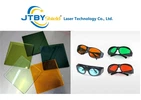


Laser safety windows are designed to protect against the harmful effects of laser radiation by absorbing and dispersing the energy of the laser beam. They are typically made from specialized materials such as sapphire, fused silica, or polycarbonate, which have high optical quality and are able to withstand high levels of laser exposure without breaking or degrading. Some key features of laser safety windows include:
1. Laser wavelength compatibility: Laser safety windows are available in different wavelength ranges to accommodate various types of lasers. The laser power rating is specific to the wavelength of the laser being used, so it is important to select a window that is compatible with the laser's wavelength. For example, a laser safety window designed for green lasers may not be suitable for red or blue lasers.
2. Thickness: The thickness of the laser safety window is an important factor in determining its laser power rating. Generally, thicker windows are required for higher-power lasers and longer distances between the laser source and the target tissue or area being treated. The thickness of the window also affects its ability to disperse the laser energy, with thicker windows providing better dispersion and absorption. For example, a 5mm thick laser safety window may be suitable for a low-power laser with a power density of up to 100 mW/cm^2, while a 10mm thick window may be required for a high-power laser with a power density of up to 500 mW/cm^2.

3. Transparency: Laser safety windows must be transparent to the wavelength of laser radiation being used in order to allow the laser beam to pass through and interact with the target tissue or area being treated. The transparency of the window is determined by its optical quality and material composition. For example, a fused silica window may have a transmission rate of up to 92% at a wavelength of 532 nm, while a sapphire window may have a transmission rate of up to 99% at the same wavelength.
4. Biocompatibility: Laser safety windows used in medical applications must be biocompatible, meaning they do not cause any adverse reactions when in contact with human tissue. This is particularly important in surgical applications, where the safety window may come into direct contact with the patient's skin or internal organs. For example, a medical-grade polycarbonate window may be coated with a biocompatible material such as titanium or tantalum to reduce the risk of tissue damage or infection.
5. Durability: Laser safety windows must be durable and able to withstand repeated exposure to laser radiation without degrading or losing their protective properties. This is particularly important in industrial and military applications, where the window may be exposed to harsh environmental conditions or impacts and shocks. For example, a sapphire window may have a durability rating of up to 1000 hours at a power density of up to 500 mW/cm^2, while a polycarbonate window may have a durability rating of up to 500 hours at the same power density.

6. Certification: Laser safety windows used in medical and military applications must be certified by recognized standards organizations such as ISO 10110-2 or ANSI Z136.1 to ensure compliance with relevant safety and performance standards. For example, a medical-grade polycarbonate window may be certified by the American National Standards Institute (ANSI) for use in surgical procedures involving visible light, ultraviolet light, and infrared light.
In conclusion, selecting the appropriate laser safety window for a particular application requires careful consideration of several factors, including wavelength compatibility, thickness, transparency, biocompatibility, durability, and certification. By selecting a window that meets these requirements