



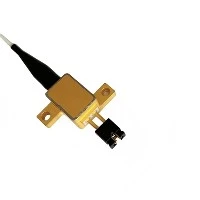
Solid-state ultraviolet lasers are divided into xenon lamp-pumped ultraviolet lasers, krypton lamp-pumped ultraviolet lasers, and new laser diode-pumped all-solid-state lasers. The photoelectric conversion efficiency of solid-state ultraviolet laser is generally low, while LD all-solid-state ultraviolet laser has the characteristics of high efficiency, high repetition frequency, reliable performance, small size, good beam quality, and stable power.
Ultraviolet lasers have unique properties, known as "cold" processing, with shorter wavelength and pulse width and low M2 (beam quality) laser can create a more focused spot, and can maintain a minimum heat affected zone (HAZ), in marking applications, can minimize the original object, reduce processing damage. For example: Glass marking, ceramic engraving, glass punching, soft circuit board cutting, and other applications, are loved by processing enterprises.
Ultraviolet laser is a light invisible to the naked eye, small spot (0.07mm), narrow pulse width, fast speed, high peak output, the use of laser high-energy laser for local irradiation of the workpiece, so that the surface material gasification or color change of the photochemical reaction, leaving a permanent sign. High power, high pulse repetition rate (PRF), pulse shaping, and pulse splitting can all contribute to improving the productivity of micromachining.
Ⅰ. Uv laser market development
In daily life, we will come into contact with a variety of trademark signs, metal or non-metal, some with text and some with patterns, such as the United States logo, mobile phone Apple logo, keyboard keys, mobile phone keys, cup graphics, cans production date, etc., many of these signs are currently achieved through ultraviolet laser marking. The reason is very simple, UV laser marking, is fast, no consumables, through the optical principle, you can print a permanent mark on the surface of various substances, which is of great help to anti-counterfeiting.
With the rapid development of science and technology, the arrival of the 5G era, especially the rapid development of the 3C industry, fast product updates, higher and higher requirements for equipment manufacturing, faster and faster, lighter and lighter weight, affordable, more and more extensive processing fields, while becoming more complex, resulting in parts manufacturing to miniaturization and precision development.
Ⅱ. Application areas of ultraviolet lasers
The UV laser has the advantages that other lasers do not have, which can limit thermal stress, reduce the damage to the workpiece during processing, and maintain the integrity of the workpiece. At present, ultraviolet lasers are used in the field of enterprise processing, mainly in four areas, glass process, ceramic process, plastic process, and cutting process.
1. glass process: glass marking can be applied to wine bottles, condiments bottles, beverage bottles, and other industries of glass bottle packaging, and can also be used for glass gifts on manufacturing, and crystal marking.
2. laser cutting: UV laser equipment can be used in many fields of flexible plate production, including FPC profile cutting, profile cutting, drilling, covering film window opening, soft and hard combination plate cover and trimming, mobile phone shell cutting, PCB profile cutting and so on
3. plastic marking: the application range includes the vast majority of general plastics and some engineering plastics, can also be used in plastic alloys such as; PC/ABS and other materials, laser marking handwriting is clear and bright, and can mark black, white handwriting.
4. ceramic carving: the application range includes tableware ceramics, vase ceramics, building supplies, ceramic bathroom, tea ceramics, etc., UV laser ceramic marking, high peak, small thermal effect, has natural advantages for similar ceramic fragile products, such as etching, engraving, cutting is not easy to damage the device, the process is precise, reduce waste of resources.

Ⅲ. Advantages of UV lasers
The high energy density of the 355nm ultraviolet laser, which passes quickly on the surface of the material, directly breaks the chemical bond of the substance, and the surface coating evaporates rapidly with each pulse, leaving an etching trace, thereby creating a cavity on the surface that can be noticed by the naked eye and the touch, and then transmitted to our field of view through the backlight, showing the graphics, text or other marks required to be etched;
In terms of processing efficiency and processing quality, excellent beam quality (M2 < 1.2) focusing spot is small, fast speed, energy concentration, causing material deformation is very small, processing surface finish is good, can achieve fine processing effect, and text pattern information is clear and durable;
No need to develop mold, can be programmed according to the need to shorten the product development cycle, and reduce costs, widely used in mobile phone manufacturing, the microelectronics industry, the automotive industry, the hardware industry, the bathroom industry radium carving process.
If compared with the screen printing process, if not carefully observed, the two processed products from the appearance of the visual effect are relatively close, but the actual substantial difference is the effect of radium engraving has light transmission, and the effect of screen printing is opaque, and the wear resistance of radium engraving is stronger than screen printing, in addition, the use of screen printing is the physical principle, the ink cost is relatively high, great harm to the environment, in contrast, The use of solid-state lasers for laser engraving has greater advantages in processing quality, processing efficiency and stability, environmental protection and so on.
Contact information:
If you have any ideas, feel free to talk to us. No matter where our customers are and what our requirements are, we will follow our goal to provide our customers with high quality, low prices, and the best service.
 Email:info@loshield.com
 Tel:0086-18092277517
 Fax: 86-29-81323155
 Wechat:0086-18092277517


