



Lasers of different wavelengths have different characteristics and applications. Therefore, lasers are widely used, including but not limited to medical, scientific research, industrial manufacturing, communications, military and other fields. For example, in the medical field, red light lasers can be used in medical mammograms; in the scientific research field, lasers of various wavelengths can be used in fine processing of materials. In general, the characteristics and applications of lasers of different wavelengths are determined by their working principles, so in practical applications, it is necessary to select the appropriate laser according to specific needs.
The main classification of lasers can be distinguished according to working medium, output power, working mode and pulse width. However, the most common classification is by gain medium, including gas lasers, liquid lasers (dye lasers), solid lasers, and semiconductor lasers.
The working substance of gas lasers is gas. The most representative one is carbon dioxide laser. The gain medium is helium and CO2. The wavelength of the generated laser is 10.6um. It is mainly used for welding of non-metallic materials (cloth, plastic, wood, etc.) On cutting and lithography machines.
Liquid lasers are also called dye lasers. Their working substances are certain organic dye solutions. The output wavelengths are mostly visible light or near-infrared light. They are used in medical, scientific research and other fields.
The working material of a solid-state laser is a luminescent center composed of metal ions that can produce stimulated radiation mixed into a crystal or glass matrix. Common solid-state lasers include ruby lasers, Nd:YAG lasers, etc.
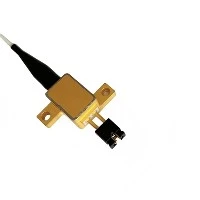
The working substance of semiconductor lasers is semiconductor materials, such as gallium arsenide, indium phosphide, etc. It has the advantages of small size, light weight, and high efficiency. It is widely used in communications, display devices and other fields.
Summary of common lasers and corresponding wavelengths:
| Laser English Abbreviation | Output Wavelength | Basic Introduction |
| ArF Laser (Argon Fluoride Laser) | 193nm | It refers to the laser light emitted when molecules formed by a mixture of inert gas and halogen gas excited by electron beams transition to their ground state, usually in the ultraviolet band. |
| KrF Laser (krypton fluoride laser) | 248nm | |
| XeCl Laser (xenon chloride excimer laser) | 308nm | |
| XeF Laser (xenon fluoride excimer laser) | 351nm | |
| HeCd Laser (Helium-Cadmium Laser) | 325nm, 441.6nm | It refers to a laser whose working substance is gas. Different from excimer lasers, gas lasers are lasers produced by atomic energy level transitions. The main excitation methods include electrical excitation, optical excitation, pneumatic excitation, etc. Gas lasers generally have very good beams quality and coherence. |
| N2 Laser (nitrogen laser, Nitrogen laser) | 337.1nm, 427nm | |
| Ar+ Laser (argon ion laser) | 488nm, 514.5nm, 351.1nm, 363.8nm | |
| HeNe Laser (helium-neon laser) | 632.8nm, 543.5nm, 594.1nm, 611.9nm, 1153nm, 1523nm | |
| Cu Laser (copper vapor laser) | 510.6nm, 578.2nm | |
| Kr+ Laser (Krypton ion laser) | 647.1nm, 676.4nm | |
| Nd:YAG Laser (YAG laser quadruple frequency) | 266nm | They are all solid-state lasers based on neodymium-doped yttrium aluminum garnet (Nd:YAG), which is the most common laser on the market. Its double frequency, triple frequency, and quadruple frequency are determined by the 1064nm band of Nd:YAG. Frequency doubling crystal (two-times frequency crystal LBO, three-times frequency crystal BBO, four-times frequency crystal CLBO) comes from frequency doubling |
| Nd:YAG Laser (YAG laser triple frequency) | 354.7nm | |
| Nd:YAG Laser (YAG laser double frequency) | 532nm | |
| Nd:YAG Laser (YAG laser) | 946nm,1064nm,1319 | |
| ruby laser | 694.3nm | The earliest invented laser is also a type of solid laser. The working material is ruby (aluminum trioxide doped with trivalent chromium). |
| Nd:Glass Laser (neodymium glass laser) | 1060nm | A solid-state laser using glass doped with neodymium ions as the working material |
| Ho:YAG Laser (holmium-doped YAG laser, holmium laser) | 2100nm | Solid laser using holmium-doped yttrium aluminum garnet as working material |
| Er:YAG Laser (erbium-doped YAG laser) | 2940nm | Solid laser using erbium-doped yttrium aluminum garnet as working material |
| diode laser (semiconductor laser) | Multiple discrete wavelengths | A semiconductor laser is a device that uses a certain semiconductor material as a working substance to generate laser light. Its working principle is generally to achieve non-equilibrium current carrying between the energy bands of semiconductor materials (conduction band and valence band), or between the energy bands of semiconductor materials and the energy levels of impurities (acceptor or donor) through electrical excitation. When a large number of electrons in the particle number inversion state recombine with holes, stimulated emission occurs. |
| QCL Laser (Quantum Cascade Laser) | Multiple discrete wavelengths | The basic principle is based on semiconductor lasers in the infrared band, which can be DFB-QCL or DBR-QCL. |
| DFB Laser (Distributed Feedback Laser) | Multiple discrete wavelengths | A type of laser in which the grating is arranged inside a semiconductor laser, and the internal periodic structures of the grating and the laser are matched to perform mode screening. |
| DBR Laser (Distributed Bragg Reflection Laser) | Multiple discrete wavelengths | Similar to DFB lasers, the grating position is different and the grating is outside the active area of the laser |
| vcsel Laser (Vertical Cavity Surface Emitting Laser) | Multiple discrete wavelengths | A laser based on semiconductor lamination technology that emits perpendicularly to the chip surface. Different from the previous semiconductor end-face emission technology, the beam quality and spot will be much better. There are a variety of discrete wavelengths, generally in the red to near-infrared band. |
| SLED (Superluminescent Light Emitting Diodes) | Multiple Discrete Wavelength Broadband Lasers | A wide-bandwidth laser between a semiconductor laser and a semiconductor diode. The bandwidth of a single laser can reach about 40nm. |
| Supercontinuum Laser | Multiple band broadband lasers | A wide-band output laser based on 1064 pulse laser pumping photonic crystal fiber. No tuning is required. It simultaneously outputs full-spectrum coverage from ultraviolet to near-infrared bands, generally covering 400nm-2400nm. Broad-spectrum output but single-band power is very low in the milliwatt range |
| dye laser (dye laser) | Multiple wavelengths, tunable | The wavelength is changed or tuned based on pulse laser pumping of dye substances. The wavelength is related to the dye substance and covers wavelengths from ultraviolet to infrared. Nitrogen molecule dye lasers are common, but dye lasers are rarely used nowadays. |
| OPO (Optical Parametric Oscillator) | Multiple wavelengths, tunable | A very wide-band laser based on the optical mixing effect, which can cover the ultraviolet to mid-infrared band |
| Ti:sapphire laser (titanium sapphire laser) | 650-1100nm tunable, 800nm | Based on titanium sapphire (aluminum trioxide doped with trivalent TI) as the working material, it can achieve continuous output, NS level pulse output and sub-PS level pulse output, and the output wavelength is tunable from 650nm to 1100nm. |
Contact Information:
If you have any ideas, feel free to talk to us. No matter where our customers are and what our requirements are, we will follow our goal to provide our customers with high quality, low prices, and the best service.
 Email:info@loshield.com
 Tel:0086-18092277517
 Fax: 86-29-81323155
 Wechat:0086-18092277517


