


LiDAR Laser Sensor actively emits laser light and can obtain information such as the distance, orientation, speed and contour of an intruding target with high precision and high resolution. It has been widely used in fields such as urban security and industrial security. This article briefly introduces the mainstream domestic and foreign security lidar manufacturers and their product technical specifications. Combining the needs of different security applications, the principles, characteristics and current situation of lidar under different technical systems are discussed from three aspects: ranging scheme, scanning method and light source selection. Finally, the application trends and development prospects of security lidar are summarized and prospected. In order to meet the needs of consumer security applications, security lidar will further develop in the directions of low cost, high performance, serialization, miniaturization, solid state, chipization and multi-source integration.
In order to detect target information, security lidar can not only directly measure the flight time of laser pulses, but also modulate the amplitude, frequency and phase of the emitted laser signal, thereby indirectly detecting the target distance. According to the detection method, security lidar ranging solutions can be divided into pulse time of flight (TOF), amplitude modulated continuous wave (AMCW) and frequency modulated continuous wave (Frequency Modulated Continuous Wave, FMCW) Three types.
Pulse TOF detection uses pulsed light signals as detection signals, and obtains target distance information by accurately measuring the flight time of reflected light pulses. The principle is shown in Figure 1. The TOF solution can be applied to security at different distances, such as perimeter security and industrial security. Its technical principle is simple and its maturity is high. At the same time, there are corresponding mature module components and dedicated processing chips for pulse laser emission, reception and processing. In addition, there are already a large number of mature TOF solutions and components that combine scanning methods, which can easily meet market demand. Most Lidars use this technical mechanism. However, there are still many problems that need to be solved urgently: the first is poor anti-interference, and the method of obtaining echo signals by direct detection is susceptible to ambient light interference, which poses safety risks; the second is low detection sensitivity and high pulse power. It puts forward higher requirements for device performance and human eye safety; the third is the problem of all-weather operation. This method is easily affected by bad weather such as rain, fog, and snow. Different security lidar manufacturers have proposed corresponding solutions. Among them, Beixing Photon TF03 security lidar uses multi-echo technology and combines compensation algorithms for outdoor strong light and rain, snow and fog environments to ensure reliable detection in harsh outdoor environments.
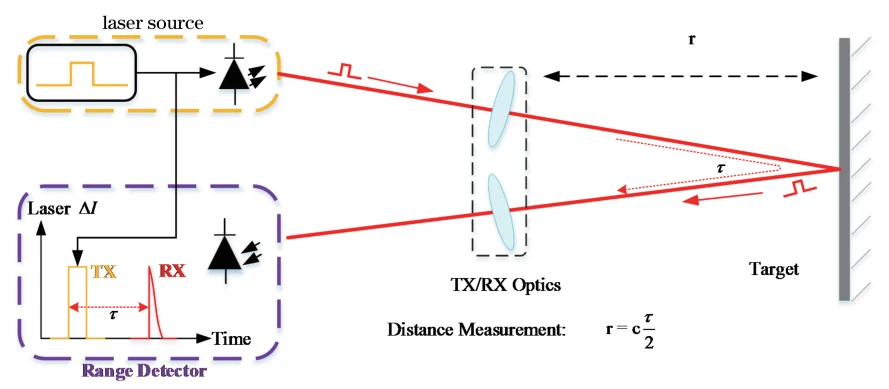
Fig. 1 Schematic of pulsed TOF LiDAR
AMCW detection is different from direct pulse detection. It emits a continuous laser signal and modulates the amplitude of the laser emission signal. The distance is measured by detecting the phase difference between the echo signal and the emission signal. The principle is shown in Figure 2. shown. AMCW is generally suitable for short to medium distances, such as detection distances of tens of meters to hundreds of meters. Its unique detection method is conducive to realizing flash scanning of solid-state area arrays. At the same time, the phase-based ranging accuracy is high, generally reaching the millimeter level.
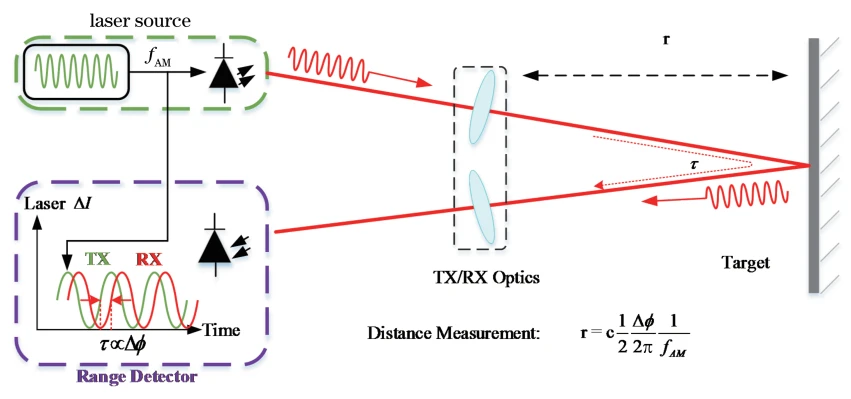
Fig. 2 Schematic of AMCW LiDAR
FMCW detection uses linear frequency modulation signals to modulate laser, and obtains target distance information and instantaneous speed by comparing the instantaneous frequency difference between the reflected light signal and the local oscillator light signal. The principle is shown in Figure 3. Compared with the first two, its outstanding advantage is that it can measure target distance and Doppler radial relative velocity at the same time, can provide 4D information, help target classification, and has a wider application field; it also has strong resistance to Interference and higher sensitivity. In addition, this detection method is suitable for low-cost mass production using silicon photonics and phased array technology, but the current technology maturity is low and the devices are relatively expensive.
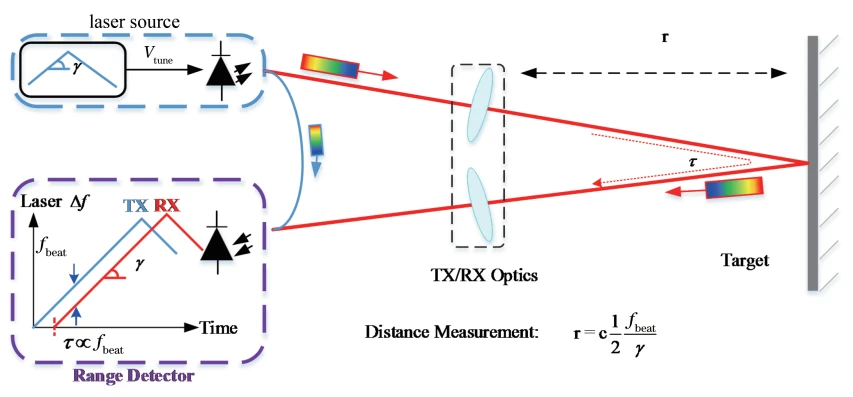
Fig. 3 Schematic of FMCW LiDAR
Each of the three ranging solutions has its own characteristics and application value. Compared with pulsed TOF detection and AMCW detection solutions, FMCW technology has significant advantages and huge potential in terms of technology maturity and cost performance. However, so far, there are still problems in the application of FMCW technical solutions in the security market. The high-performance components required are costly and cannot be manufactured in large quantities. With the development of semiconductor technology, using photonic integration technology to build on-chip integrated lidar is an important trend in future development.
Contact information:
If you have any ideas, feel free to talk to us. No matter where our customers are and what our requirements are, we will follow our goal to provide our customers with high quality, low prices, and the best service.
 Email:info@loshield.com
 Tel:0086-18092277517
 Fax: 86-29-81323155
 Wechat:0086-18092277517


