



Laser protective lenses and focusing lenses are two critical optical components in laser systems. Although they may appear similar in appearance, they differ significantly in terms of function, material selection, application scenarios, and design principles. Below is a detailed exploration of the differences between these two types of lenses and an analysis of their importance in laser technology.
I. Function and Characteristics of Laser Protective Lenses
1. Primary Function
The core role of laser protective lenses is to protect the internal optical components and the laser itself from contamination or damage. During laser processing, dust, metal spatter, or chemical gases may be generated. If these contaminants enter the laser optical path, they can degrade the output quality of the laser or even damage expensive optical components. Protective lenses serve as the first line of defense, effectively blocking these contaminants.
Additionally, laser protective lenses can reduce laser reflection and scattering, preventing energy loss or harm to the surrounding environment.
2. Material Selection
The materials used for laser protective lenses must possess the following characteristics:
High transmittance: Ensures efficient passage of laser energy, minimizing energy loss.
High damage threshold: Withstands high-power laser irradiation without damage.
Thermal resistance: Maintains stability under high-temperature conditions.
Corrosion resistance: Resists erosion from chemical gases or liquids.
Common materials include:
Quartz glass: Offers high transmittance and excellent thermal resistance, suitable for most laser systems.
K9 optical glass: Cost-effective, suitable for low-power lasers.
Coated materials: Anti-reflective or reflective coatings are applied to enhance performance.
3. Application Scenarios
Laser protective lenses are widely used in the following fields:
Laser cutting and welding: Prevents metal spatter from contaminating the optical system.
Laser marking: Blocks dust and debris.
Medical laser devices: Protects the laser from contamination, ensuring hygiene.
4. Design Features
Laser protective lenses are typically designed as flat lenses and are installed near the laser output or the starting point of the optical path. Their structure is simple but requires regular cleaning or replacement to maintain protective performance.

II. Function and Characteristics of Focusing Lenses
1. Primary Function
The main role of focusing lenses is to concentrate the laser beam into a small spot, thereby increasing the energy density of the laser. The focused laser beam enables high-precision processing, such as cutting, welding, drilling, and micro-machining. The performance of the focusing lens directly affects the quality and efficiency of laser processing.
2. Material Selection
The materials used for focusing lenses must meet the following requirements:
High transmittance: Ensures efficient passage of laser energy.
Low absorption rate: Minimizes energy loss and prevents lens overheating.
High optical uniformity: Ensures the quality of the focused laser beam.
Common materials include:
Zinc selenide (ZnSe): Suitable for CO₂ lasers, offering high transmittance and low absorption.
Calcium fluoride (CaF₂): Suitable for ultraviolet lasers, providing excellent optical performance.
Fused silica: Suitable for multiple laser wavelengths, with a high damage threshold.
3. Application Scenarios
Focusing lenses are widely used in the following fields:
Laser cutting: Focuses the laser beam onto the material surface for high-precision cutting.
Laser welding: Concentrates the laser beam to generate high temperatures for material fusion.
Laser marking: Achieves fine patterns or text through focusing.
Medical lasers: Used in laser surgery or therapy, focusing the laser beam to precisely target tissues.
4. Design Features
Focusing lenses are typically designed as convex or aspherical lenses. Their curvature and thickness are precisely calculated to ensure the laser beam is focused to the desired spot size. The focal length of the focusing lens is a critical parameter, determining the position and size of the focal point.
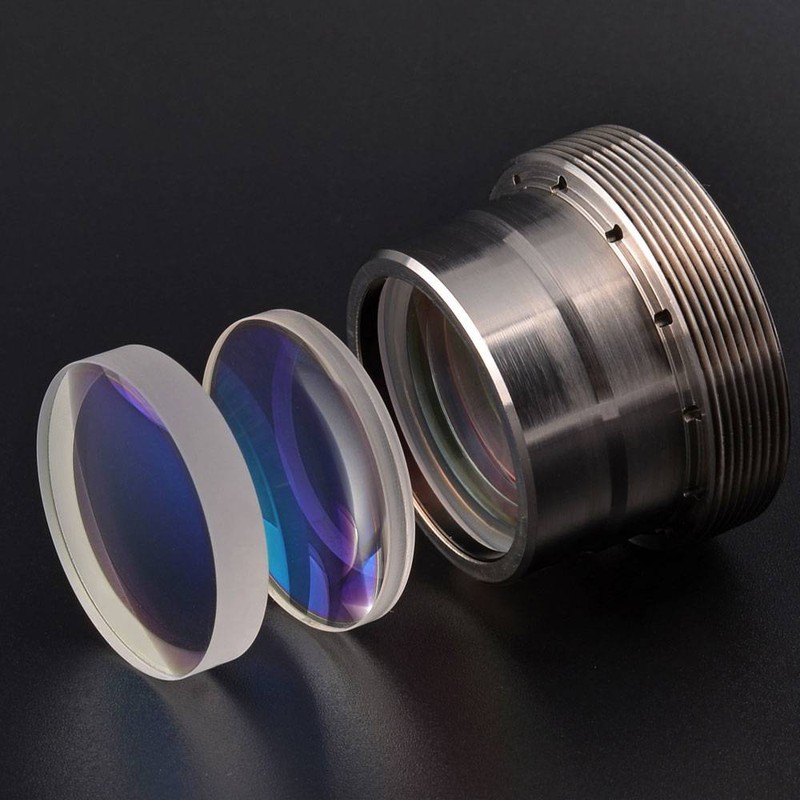
III. Key Differences Between Laser Protective Lenses and Focusing Lenses
1. Functional Differences
Protective lenses: Primarily used for protection, preventing contaminants from entering the laser system.
Focusing lenses: Primarily used for focusing the laser beam to increase energy density.
2. Material Differences
Protective lenses: Emphasize damage resistance and thermal stability.
Focusing lenses: Emphasize optical performance and focusing efficiency.
3. Application Differences
Protective lenses: Used for protection, applicable to all laser systems.
Focusing lenses: Used for processing, applicable in scenarios requiring high energy density.
4. Design Differences
Protective lenses: Typically flat lenses with a simple structure.
Focusing lenses: Typically convex or aspherical lenses with a complex design.
IV. Maintenance and Care for Laser Protective Lenses and Focusing Lenses
1. Maintenance of Protective Lenses
Regularly inspect the lens surface for contamination or damage.
Clean the lens using specialized tools and cleaning agents.
Replace the lens promptly if it is damaged or heavily contaminated.
2. Maintenance of Focusing Lenses
Avoid mechanical impact or scratches on the lens.
Regularly check the focusing performance to ensure the spot size meets requirements.
Clean the lens surface using professional methods if contamination occurs.
V. Conclusion
Laser protective lenses and focusing lenses play different roles in laser systems, but both are indispensable components. Protective lenses ensure the stable operation of laser systems by blocking contaminants and reducing reflections, while focusing lenses enable high-precision processing by concentrating the laser beam into a small spot. They differ significantly in material selection, design principles, and application scenarios, but together they provide critical support for the efficient application of laser technology.
In practical applications, users must select the appropriate lenses based on the specific requirements of their laser systems and perform regular maintenance to ensure efficient operation and long-term stability. As laser technology continues to advance, the performance of laser protective lenses and focusing lenses will further improve, supporting applications in more fields.