

Ask an equipment engineer about laser viewing windows, and the conversation will usually turn to wavelengths before anything else. A window designed for a UV marking machine isn't automatically suitable for a fiber laser operating at 1064 nm. The two machines might have similar housings, but the protection they need can be quite different.
This is something manufacturers have to account for when choosing window materials, particularly if they produce several types of laser equipment.
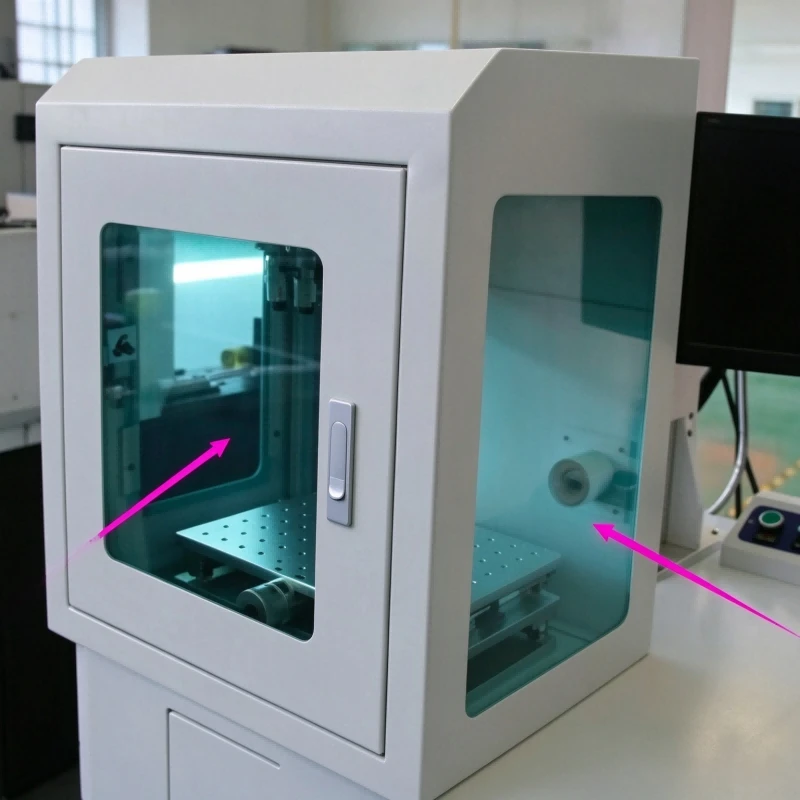
One Film, Several Wavelengths?
The idea behind multi-wavelength laser protection films is fairly simple: a single material can attenuate laser radiation at more than one specified wavelength range.
What matters is how much radiation gets through at each wavelength.
Take optical density (OD), for example. An OD 4 rating means that only 0.01% of the incident radiation is transmitted at the wavelength where that rating applies, assuming the material remains within its tested conditions.
But the same film might have a completely different OD rating elsewhere in the spectrum. That's why a general description such as "UV and IR protection" isn't enough to make a purchasing decision.
For an equipment manufacturer, the wavelength chart is often more useful than the product name.

What Happens at the Viewing Window?
A laser machine needs more than a protective enclosure. In many cases, someone still needs to see what's going on inside.
Think about a marking machine processing a batch of metal parts. The operator may need to check whether the workpiece is correctly positioned or whether the marking process is running as expected. If the window is too dark, those checks become difficult.
Visible light transmission (VLT) therefore deserves attention alongside OD ratings.
Window construction matters too. Glass, acrylic and polycarbonate don't necessarily behave the same way when a film is applied. Adhesion, temperature, cleaning procedures and long-term use can all affect material selection.
A separate concern is what happens if the laser beam strikes the window directly. High OD doesn't automatically mean the film can tolerate that exposure. The entire window assembly has to be assessed for the laser power and operating conditions involved.
Looking at JTBYShield's Film Options
JTBYShield offers two laser safety window film models, XL-JM-F01 and XL-LSF02, with different wavelength coverage.
For example, XL-JM-F01 is specified at OD 4+ across 190–370 nm and OD 2.5+ across 950–1060 nm. XL-LSF02 has an OD 10+ rating across 200–372 nm and OD 4+ across 962–1062 nm.
These differences are worth checking carefully. A film's rating at one wavelength cannot be assumed to apply to another, even when the wavelengths are relatively close.
The products use multilayer PET-based construction, with approximately 60% visible light transmission listed in the product information. Custom cutting is available for equipment manufacturers working with different window dimensions.
Full wavelength specifications can be found on the JTBYShield Laser Safety Window Film page.

Before Choosing a Film
For OEM manufacturers, the most useful starting point is a list of the laser wavelengths used in the machine, followed by the expected power and exposure conditions.
Once those details are known, the film's OD ratings, visible light transmission and substrate compatibility can be reviewed together. The finished window must also meet the applicable laser safety requirements.
If you're comparing materials for a new enclosure or a replacement viewing window, JTBYShield can provide film specifications and custom sizing information for your project.