


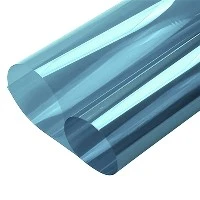

Laser protection materials can be divided into two types according to the principle: laser protection materials based on the principle of linear optics and laser protection materials based on the principle of nonlinear optics. The laser protective materials based on the principle of linear optics include absorption, reflection, absorption-reflection, holographic materials, etc. The laser protective materials based on the principle of nonlinear optics mainly include nonlinear absorption, nonlinear refraction, nonlinear scattering, and nonlinear reflection materials.
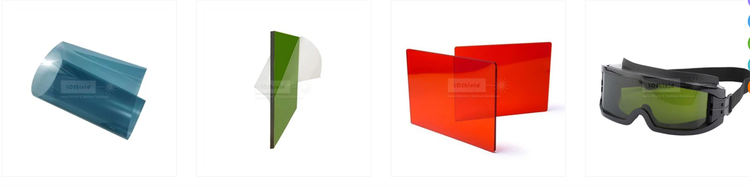
1. Laser protection material based on the linear optical principle
1.1 Absorbent photoprotective material
In laser protection materials, the absorbent is the most widely used material. Filters made of absorbent materials are inexpensive, simple to manufacture, and easy to use.
The absorption filter mainly uses the dye to selectively absorb the laser of a specific wavelength to achieve laser protection. It can be divided into two categories: the category is the addition of organic dyes plastic; The other type is glass mixed with inorganic absorbent. The filter combined with plastic and organic dyes has the advantages of simple structure, lightweight, easy to use, low cost, high optical density, good laser absorption effect, and strong impact resistance, but the surface is easy to scratch, organic dyes may be saturated or discolored when exposed to strong laser irradiation in plastics, thus losing the protective effect, and the plastic substrate is easy to age in the environment and is not resistant to chemical agents. The filter composed of glass and inorganic filler has the advantages of high hardness, good transparency, good stability, can withstand strong laser irradiation, is less affected by the environment and the surface is not easy to scratch, but the impact resistance is poor.
Although the absorption filter has strong absorption of specific wavelength laser irradiation, the visible light transmittance will decrease significantly with the increase of optical density. The protective band of the absorption filter is relatively wide, and when the laser of a specific wavelength is strongly absorbed, the light transmittance near the wavelength is also significantly reduced, thus darkening and coloring the field of view, which makes the human eye easy to fatigue and discomfort [10]
There is a report on a laser-protective plastic laminated glass, which is mainly made of two kinds of protective material phase composite methods, so as to improve the comprehensive technical indicators of laser protection and improve the visible light transmittance. The glass has good wear resistance, strong aging resistance but poor impact resistance. The wear resistance and aging resistance of plastics are poor, but the impact strength is high. Therefore, after the composite of the two materials, their comprehensive properties can be improved.
1.2 Reflective protective material
Reflective laser protection materials are characterized by selective total reflection and selective transmission of light waves of different wavelengths using multilayer dielectric optical films. The vacuum coating technology is used to lock multilayer films with different refractive indices on the optical glass, so as to realize the reflection of specific wavelength laser
Because the reflective laser protection material reflects the laser instead of absorbing the laser, it can withstand higher-intensity laser irradiation than the absorbent laser protection material. When the transmittance of laser energy is low and the reflectivity is related to the laser Angle, the reflected wavelength changes with the change of the field of view Angle. Therefore, it can only have an effective protection effect within the range of a certain Angle, and the process requirements are relatively high
At present, China has a patent on the development of a reflective filter, which is a full-reflection laser protection mirror. Multilayer dielectric optical film is plated on a flat optical glass substrate by vacuum coating technology. By selecting suitable dielectric material and proper plating process, it has high reflection to different wavelengths of laser in the range of 300~1400nm and has good transparency to visible light.

1.3 Composite laser protection materials
A composite material that combines the functions of absorbent and reflective laser protection materials can protect multi-band lasers at specific wavelengths.
This material integrates the advantages of comprehensive absorbing material and reflective material in one, not only can achieve a high optical density, but also can ensure a certain visible light transmittance, and the protection effect is good.
There are also related reports on the research of compound laser protective materials in China. The material consists of a substrate and a multilayer dielectric film. It is characterized by the use of special glass with low-pass filtering characteristics as the substrate. A multi-layer reflective dielectric film with a non-quarter film system is steamed on the substrate to form a mixed absorption-reflection structure. The transparency of the protective lens is 30%. The optical focus of the lens is 4 to 6m-1. It has the function of protecting a variety of wavelengths.
1.4 Holographic laser protection materials
Holographic laser protection material is based on the holographic optical principle, the use of the holographic photography method on the glass or plastic substrate to produce three-dimensional phase grating. According to the Bragg diffraction principle, when the laser incidence Angle meets the Bragg condition, an extremely strong first-order diffractive light will be produced, thus reflecting the laser away. Different hologram interference fringes correspond to different wavelengths, so the specific wavelength of the laser can be reflected by controlling the spacing of hologram interference fringes, so as to achieve a laser protection effect. The advantage of this material is that the laser reflection band is narrow, which can effectively reflect the specific wavelength of the laser, and at the same time has a high transmittance; The disadvantage is that the field of view Angle is limited, the production cost is high, and the process requirements are very high.
Contact information:
If you have any ideas, feel free to talk to us. No matter where our customers are and what our requirements are, we will follow our goal to provide our customers with high quality, low prices, and the best service.
 Email:info@loshield.com
 Tel:0086-18092277517
 Fax: 86-29-81323155
 Wechat:0086-18092277517


