




Laser protection glasses are specialized optical filters designed to reduce the intensity of specific laser wavelengths to safe levels, preventing eye injury such as retinal burns or permanent vision loss. Unlike ordinary sunglasses, they function based on precise physical principles and must meet defined safety standards. This explanation focuses on their fundamental operation, key technical parameters, and essential selection criteria-without reference to commercial products or unverified claims.
Core Working Principles
1. Attenuation Mechanisms
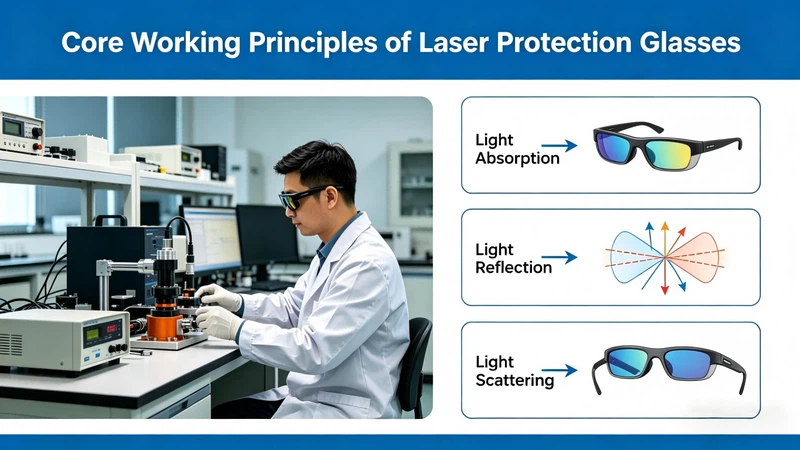
Laser protection glasses primarily use two physical mechanisms to reduce laser energy:
Absorption: The lens material contains compounds that absorb photons at specific wavelengths, converting laser energy into a small amount of heat. This method is effective across a range of angles and is commonly used for visible and near-infrared lasers.
Reflection (Interference Filtering): Thin-film coatings on the lens surface reflect targeted wavelengths through optical interference. This approach offers high attenuation with minimal heating but may be less effective at oblique angles.
Many protective lenses combine both methods to achieve broad and reliable protection.
2. Optical Density (OD): The Key Metric
Optical Density quantifies how effectively a lens reduces laser power:
OD=log10(Incident PowerTransmitted Power)OD=log10(Transmitted PowerIncident Power)
OD 3 reduces laser intensity by a factor of 1,000 (0.1% transmission).
OD 6 reduces it by 1,000,000 (0.0001% transmission).
For example, a 1 watt (1000 mW) laser at a given wavelength will transmit only 1 microwatt through an OD 6 filter-typically below the eye's damage threshold for brief exposure.
⚠️ Important: Protection is wavelength-specific. A filter rated for 532 nm (green) offers little or no protection against 1064 nm (infrared), even if the lens appears dark.
Critical Selection Criteria
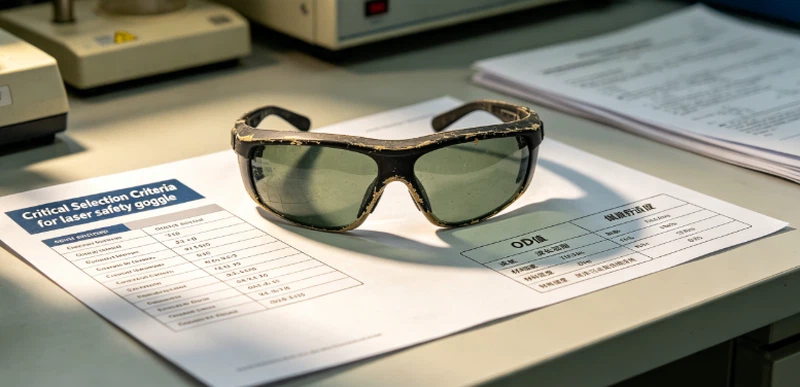
1. Wavelength Match
Laser safety eyewear must be selected based on the exact emission wavelength(s) of the laser in use. Many lasers-especially frequency-doubled solid-state types-emit both visible light and invisible infrared radiation (e.g., 532 nm + residual 1064 nm). Protection must cover all relevant wavelengths.
2. Required Optical Density
The necessary OD depends on:
Laser output power or energy
Exposure duration (continuous wave vs. pulsed)
Distance from the source
Applicable safety standards (e.g., IEC 60825-1)
Safety guidelines define the Maximum Permissible Exposure (MPE)-the highest irradiance considered safe. Eyewear must reduce incident laser levels below this threshold.
3. Damage Threshold
In high-power applications, the lens itself must resist damage from direct or reflected beams. International standards (such as EN 207) require eyewear to withstand direct exposure without melting, cracking, or losing protective properties. This is distinct from standards that only consider transmitted power (e.g., ANSI Z136.1).
4. Visible Light Transmission (VLT)
While blocking hazardous wavelengths, the lens should allow sufficient visible light for safe operation. High OD often reduces VLT, potentially impairing visibility. A balance must be struck based on the work environment.
Common Misconceptions and Risks
"Dark lenses = safe": Tinted glass without verified OD ratings provides no reliable protection, especially against invisible wavelengths like IR or UV.
"One pair fits all lasers": A filter effective for one wavelength may be transparent to another. Using mismatched eyewear creates a false sense of security.
Degradation over time: Absorptive materials can degrade due to prolonged exposure, UV aging, or chemical contamination, reducing effectiveness. Regular inspection and replacement are necessary.
Angle dependence: Interference-based filters may lose performance when the beam strikes at steep angles, which is critical in environments with scattered reflections.
Relevant Safety Standards (Overview)
Two major frameworks guide laser eyewear design and testing:
IEC 60825-1 / EN 207 (International/European): Requires eyewear to not only attenuate laser light but also withstand direct exposure without failure. Labels include wavelength and a "protection level" (e.g., for continuous or pulsed operation).
ANSI Z136.1 (United States): Focuses on ensuring transmitted irradiance remains below the MPE. It does not always mandate resistance to direct beam impact.
For high-power or industrial lasers, standards requiring physical durability under direct exposure provide a higher margin of safety.
Summary: Essential Guidelines
Match the wavelength exactly-including any secondary emissions (e.g., IR leakage).
Verify required OD based on laser parameters and safety regulations.
Prefer eyewear tested for direct beam resistance in high-power settings.
Inspect regularly for scratches, discoloration, or damage.
Never assume appearance correlates with protection-only certified specifications matter.
🔒 Final Note:
Laser protective eyewear is a critical engineering control-not an accessory. Its effectiveness relies entirely on correct specification, proper use, and adherence to recognized safety standards.
References (Standards Only)
IEC 60825-1: Safety of laser products – Part 1: Equipment classification and requirements.
EN 207: Personal eye protection against laser radiation.
ANSI Z136.1: American National Standard for Safe Use of Lasers.
These documents define test methods, labeling requirements, and performance criteria used globally to ensure laser eye protection is both effective and reliable.