


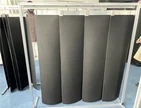

Laser safety curtains-flexible barriers designed to attenuate hazardous laser radiation-are critical components in controlled laser environments. A common and essential installation practice is overlapping adjacent curtain panels. This configuration is not merely permissible; it is a fundamental engineering measure to ensure continuous optical shielding and compliance with international laser safety standards. This document explains the technical rationale, design considerations, and safety implications of overlapping laser safety curtains.
Why Overlap Is Necessary
Laser beams, particularly from Class 3B and Class 4 systems, can cause severe eye or skin injury even from diffuse reflections. Any gap between barrier segments creates a potential pathway for radiation leakage. Overlapping eliminates direct line-of-sight through seams, ensuring that:
No unattenuated beam can pass between panels;
Scattered or reflected radiation is further attenuated by passing through multiple layers;
Mechanical tolerances (e.g., thermal expansion, vibration, or misalignment) do not compromise protection.
This approach aligns with the principle of fail-safe design: even under minor displacement, the barrier remains effective.

Technical Implementation Guidelines
1. Overlap Width
While specific dimensions depend on the application, a general engineering guideline is:
Minimum overlap of 50–100 mm for most industrial and laboratory settings.
Larger overlaps may be required for high-power lasers, wide-beam applications, or environments with significant movement or airflow.
The overlap must be sufficient to maintain coverage under worst-case operational conditions (e.g., curtain sway or equipment vibration).
2. Layer Orientation
Overlapping should be arranged to prevent straight-line optical paths. For example:
Vertical seams: Upper panel overlaps the lower one outward (like roof shingles), so incident light must reflect at least twice to penetrate.
Horizontal seams: Side panels overlap in a consistent direction to avoid "slit" formation.
This labyrinth effect increases the effective optical path length through the material, enhancing attenuation beyond single-layer performance.
3. Material Consistency
All overlapping sections must be fabricated from the same protective material, with identical:
Optical Density (OD) at the relevant laser wavelength(s);
Damage threshold (resistance to burning or melting under direct exposure);
Spectral attenuation profile (especially critical for multi-wavelength lasers, e.g., 1064 nm + 532 nm).
Inconsistent materials create weak points where protection drops below required levels.
4. Mounting and Tension
Curtains must be:
Securely anchored to prevent separation;
Maintained under uniform tension to avoid sagging or billowing;
Free of punctures, tears, or degradation at overlap zones.
Hardware (e.g., rails, clips) should not compress or distort the material in a way that reduces effective thickness or creates gaps.

Compliance with International Standards
The IEC 60825-4 standard ("Safety of laser products – Part 4: Laser guards") governs the design and performance of laser protective barriers, including flexible curtains. While it does not prescribe a fixed overlap dimension, it mandates:
"Laser guards shall be designed to prevent access to hazardous radiation under all reasonably foreseeable conditions of use, including maintenance and adjustment."
- IEC 60825-4:2022, Clause 5.2
This implies that joints, seams, and interfaces must not permit radiation leakage above the Maximum Permissible Exposure (MPE). Overlapping is the most reliable method to satisfy this requirement for flexible barriers.
Additionally, the standard requires that protective materials:
Maintain specified OD over time;
Resist ignition or degradation when exposed to the maximum expected irradiance;
Be labeled with wavelength and OD ratings.

Common Installation Errors to Avoid
| Error | Risk | Corrective Action |
|---|---|---|
| Butted edges with no overlap | Direct beam leakage through seam | Ensure minimum 50 mm overlap |
| Inconsistent overlap direction | Formation of linear gaps | Standardize overlap orientation (e.g., always left-over-right) |
| Using degraded or mismatched panels | Reduced OD at seam | Inspect and replace uniformly; verify material specs |
| Loose mounting | Dynamic gaps during operation | Use tensioning systems and secure fasteners |
Verification and Maintenance
After installation:
Perform a visual inspection to confirm continuous overlap under operational conditions.
Conduct radiation leakage testing using a calibrated power meter or detector at seam locations, especially for invisible wavelengths (e.g., IR).
Re-inspect regularly, as material fatigue, UV exposure, or mechanical wear can compromise overlap integrity over time.
Conclusion
Yes, laser safety curtains can and should overlap. Overlapping is a proven, standards-aligned method to eliminate radiation leakage through seams. Proper implementation-considering overlap width, orientation, material consistency, and mechanical stability-is essential to maintaining a safe laser-controlled area. Always base design decisions on the specific laser parameters (wavelength, power, pulse characteristics) and applicable safety regulations, ensuring that the entire barrier system, including joints, provides uniform and reliable protection.