



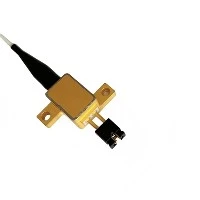
HeNe laser is a typical representative of gas lasers. The output beam has a Gaussian distribution and stable beam quality. Although the power is not high, it performs well in the field of precision measurement.

Frequency Stabilized HeNe lasers are developed on the basis of a high degree of integration of laser physics, spectroscopy and electronics. Their importance lies in providing a light source with high spectral purity and frequency stability.

In modern science and technology, frequency stabilization technology has become a key component of basic scientific research and cutting-edge science. Frequency-stabilized HeNe lasers are widely used in fields that require high-precision frequency control and stability, such as precision measurement, optical sensing and quantum metrology.
HeNe laser
1. Basic principle
Helium-neon (HeNe) laser is a laser that uses gas as a gain medium. Its working principle is based on gas discharge excitation, population inversion and laser emission process. In HeNe laser, helium and neon work together, where helium is responsible for improving pumping efficiency, while neon provides the energy level structure required for laser emission.
When the gas discharges, helium atoms are excited to a high energy state, and then transfer energy to neon atoms through collision, causing the neon atoms to reach an excited state. These excited neon atoms release photons when they return to the ground state, thereby generating laser light.
2. Features
High monochromaticity: The laser output by HeNe laser has extremely high spectral purity, and its central wavelength is usually very stable, which makes it very useful in precision measurement and scientific research.
High directivity: The laser beam generated by HeNe laser has a small divergence angle and good directivity, which makes it perform well in long-distance transmission and high-precision positioning applications.
High stability: Due to the cavity design and gas characteristics of HeNe laser, its output power and frequency stability are very high, which is critical for applications that require long-term stable operation.
3. Application
Scientific research: HeNe lasers are widely used in scientific research fields such as spectral analysis and interferometry. Its high monochromaticity and stability make it an important tool for studying the structure and properties of matter.
Industrial application: In the industrial field, HeNe lasers are used in high-precision processing processes such as laser cutting and laser welding. Although its output power is relatively low, its high stability and directionality make it still advantageous in certain specific applications.
Frequency Stabilized HeNe Laser
1.Principle
Frequency-stabilized HeNe lasers achieve frequency stability through frequency stabilization technology. An iodine absorption cell is used for frequency locking. When the laser frequency coincides with the absorption peak of the iodine molecule, the signal change is detected by a photodetector, and the cavity length is adjusted by feedback to ensure that the laser frequency is stable on the absorption peak.
2. Type
Frequency-stabilized HeNe lasers are mainly divided into Lamb dip frequency-stabilized lasers and Zeeman effect frequency-stabilized lasers. Lamb dip frequency stabilization adjusts the absorption peak position by controlling the gas pressure, while Zeeman effect frequency stabilization uses the magnetic field to split the energy level and improve the frequency stability.
3. Frequency stabilization mechanism
Frequency stabilization mechanisms include saturation absorption technology and the absorption characteristics of iodine molecules. Saturation absorption technology increases the light intensity to saturate the absorption, thereby obtaining a stable absorption signal. Iodine molecules have sharp absorption peaks at specific wavelengths for precise frequency locking.
The main differences and advantages and disadvantages of HeNe laser and frequency-stabilized HeNe laser:
Main differences
1. Frequency stability
HeNe laser: The frequency stability of ordinary HeNe laser is relatively low and is greatly affected by environmental factors, such as temperature fluctuations and mechanical vibration.
Frequency-stabilized HeNe laser: Through frequency-stabilizing technology, such as iodine absorption cell or saturable absorption technology, extremely high frequency stability is achieved, usually better than 10^-12.
2. Application fields
HeNe laser: widely used in general scientific research, industrial processing (such as laser cutting, welding) and education.
Frequency-stabilized HeNe laser: Mainly used in fields that require high-precision frequency control, such as length reference, frequency reference, quantum physics research, and high-precision measurement.
3. System complexity
HeNe laser: The structure is relatively simple, and the operation and maintenance are relatively easy.
Frequency-stabilized HeNe laser: Due to the introduction of complex frequency stabilization technology and high-precision control systems, the system complexity has increased significantly, and the maintenance difficulty has also increased.
4. Cost
HeNe laser: The manufacturing and maintenance costs are relatively low, making it suitable for mass production and wide application.
Frequency-stabilized HeNe lasers: Due to the use of advanced frequency stabilization technology and precision components, manufacturing and maintenance costs are high, limiting their popularity in applications with limited budgets.
Comparison of advantages and disadvantages
1. Advantages
HeNe laser: low cost, simple structure, easy to operate and maintain, suitable for a wide range of general applications.
Frequency-stabilized HeNe laser: It has extremely high frequency stability and precision, and is suitable for key areas that require precise frequency control.
2. Disadvantages
HeNe laser: poor frequency stability, not suitable for high-precision measurement and scientific research.
Frequency-stabilized HeNe laser: high cost, complex system, difficult maintenance, and high technical requirements for operators.
In summary, HeNe lasers and frequency-stabilized HeNe lasers have their own advantages in principle, characteristics and applications. Traditional HeNe lasers have a wide range of applications in many fields due to their high monochromaticity, high directivity and stability; while frequency-stabilized HeNe lasers have further improved their frequency stability and service life by introducing advanced frequency stabilization technology, providing a more reliable tool for high-precision measurement and scientific research. With the advancement of science and technology and the deepening of research, we have reason to believe that frequency stabilization technology will continue to be optimized and improved, promoting the continuous improvement of laser performance. At the same time, cost control and system simplification will also be important directions for the development of frequency-stabilized HeNe lasers in the future. Looking to the future, we can look forward to the arrival of a more efficient, stable and economical laser era, opening up a broader space for human scientific research and industrial applications.
Contact information:
If you have any ideas, feel free to talk to us. No matter where our customers are and what our requirements are, we will follow our goal to provide our customers with high quality, low prices, and the best service.
 Email:info@loshield.com
 Tel:0086-18092277517
 Fax: 86-29-81323155
 Wechat:0086-18092277517


