


Laser technology has entered people's lives from all aspects, but there are many types of Lasers, each with different wavelengths and characteristics, so the fields of application are also different.
According to the working medium, lasers are divided into six types: solid lasers, gas lasers, dye lasers, semiconductor lasers, fiber lasers and free electron lasers. Among them, solid lasers and gas lasers have many subdivisions. Except for free electron lasers, the basic working principles of various lasers are the same, including three parts: pump source, optical resonant cavity and gain medium.
Solid Lasers, light is generally used as the pump source, and the crystal or glass that can generate laser is called laser working material. The laser working material consists of two parts: matrix and activation ions. The matrix material provides a suitable existence and working environment for the activation ions, and the activation ions complete the laser generation process. Commonly used activation ions are mainly transition metal ions, such as chromium, cobalt, nickel ions and rare earth metal ions, such as neodymium ions. The reflector with a dielectric film on the surface is used as the resonant cavity lens, one of which is a full reflector and the other is a half reflector. When different activation ions, different matrix materials and different wavelengths of light are used for excitation, lasers of various wavelengths will be emitted.
1. Ruby laser
The output laser wavelength is 694.3nm, and the photoelectric conversion rate is low, only 0.1%. However, its fluorescence life is long, which is conducive to energy storage and can output higher pulse peak power. The laser generated by a ruby rod as thin as a pen core and as long as a finger can easily penetrate iron sheet. Before the emergence of more efficient YAG lasers, ruby lasers were widely used in laser cutting and drilling. In addition, 694nm light is easily absorbed by melanin, so ruby lasers are also used to treat pigmented lesions (skin spots).
2. Titanium sapphire laser
Due to its crystal properties, it has a wide tunable range (i.e., adjustable wavelength range), and can output light with a wavelength of 660nm-1200nm as needed. With the maturity of frequency doubling technology (which can double the frequency of light, i.e., halve the wavelength), the wavelength range can be expanded to 330nm-600nm. Titanium sapphire lasers are used for femtosecond spectroscopy, nonlinear optical research, generation of white light, generation of terahertz waves, etc., and are also used in medical beauty.
3. Nd: YAG laser
YAG is the abbreviation of yttrium aluminum garnet. This material is the laser crystal matrix with the best comprehensive characteristics at present. After being doped with neodymium (Nd), it can output 1064nm light, and the maximum continuous output power can reach 1000w. In the early days, inert gas flash lamps were used as the pumping source of lasers, but the flash lamp pumping method has a wide spectral range, poor overlap with the absorption spectrum of the laser gain medium, and a large heat load, resulting in low photoelectric conversion efficiency. Therefore, LD (laser diode) pumping is now used to achieve high efficiency, high power and long life of the laser. Nd: YAG lasers can be used to treat hemangiomas and inhibit tumor growth. However, this laser has non-selective thermal damage to tissues. While coagulating the blood vessels of the tumor, the excess energy will also damage the surrounding normal tissues, and scars are likely to be left after surgery. Therefore, Nd: YAG lasers are mostly used in surgery, gynecology, and ENT, but rarely in dermatology.
4.Yb:YAG laser
Yb:YAG, YAG is doped with ytterbium (Yb), which can output 1030nm light. The pump wavelength of Yb:YAG is 941nm, which is very close to the output wavelength, and can achieve a pump quantum efficiency of 91.4%. The heat generated by the pump is suppressed to less than 10% (most of the input energy is converted into the energy of the output laser, and a small part becomes heat, which means that the conversion efficiency is very high), which is 25% to 30% of Nd:YAG. Yb:YAG has become one of the most eye-catching solid laser media. LD-pumped high-power Yb:YAG solid lasers have become a new research hotspot and are regarded as a major direction for the development of high-efficiency and high-power solid lasers.
In addition to the above two types, YAG can also be doped with holmium (Ho), erbium (Er), etc. Ho:YAG can produce 2097nm and 2091nm lasers that are safe for human eyes, mainly suitable for optical communications, radar and medical applications. Er:YAG outputs 2.9μm light, and the human body has a high absorption rate for this wavelength, so it has great application potential in laser surgery and vascular surgery.

Gas Lasers are lasers that use gas as a gain medium, generally pumping gas discharge (similar to solid-state lasers, so I won't go into detail). Gas types include atomic gases (helium-neon lasers, noble gas ion lasers, metal vapor lasers), molecular gases (nitrogen lasers, carbon dioxide lasers), excimer gases, and special gas lasers that provide pumping energy through chemical reactions.
1. He-Ne lasers
HeNe laser (HeNe) uses a mixed gas of more than 75% He and less than 15% Ne as the gain medium. Depending on the working environment, it can emit green (543.5nm), yellow (594.1nm), orange (612.0nm), red (632.8nm) and three near-infrared lights (1152nm, 1523nm and 3391nm), of which red light (632.8nm) is the most commonly used. The beam output by the HeNe laser is Gaussian distributed, and the beam quality is very stable. Although the power is not high, it has a good performance in the field of precision measurement.

2. Inert gas laser
Common inert gas lasers are argon ions (Ar+) and krypton ions (Kr+). Its energy conversion rate can reach up to 0.6%, and it can output 30-50w of power continuously and stably for a long time, with a lifespan of more than 1000h. It is mainly used in research fields such as laser display, Raman spectroscopy, holography, nonlinear optics, as well as medical diagnosis, printing color separation, metrology, material processing and information processing.
3. Metal vapor laser
Metal vapor lasers take copper vapor as an example. Copper vapor lasers mainly output green light (510.5nm) and yellow light (578.2nm), which can reach an average power of 100w and a peak power of 100kw. Its main application area is the pump source of dye lasers. In addition, it can also be used for high-speed flash photography, large-screen projection televisions and material processing.
4. Nitrogen molecular laser
Nitrogen molecular laser uses nitrogen as the gain medium and can emit ultraviolet light of 337.1nm, 357.7nm and 315.9nm, with a peak power of up to 45kw. It can be used as a pump light source for organic dye lasers, and is also widely used in laser separation of isotopes, fluorescence diagnosis, ultra-high-speed photography, pollution detection, medical care, agricultural breeding and other aspects. Because its short wavelength makes it easier to focus to obtain a small spot, it can also be used to process submicron components.
5. Carbon dioxide laser
The gain medium used in carbon dioxide lasers is carbon dioxide mixed with helium and nitrogen, which can output far-infrared light centered at 9.6μm and 10.6μm wavelengths. The energy conversion rate of carbon dioxide lasers is high, and the output power can range from a few watts to tens of thousands of watts. Coupled with the extremely high beam quality, carbon dioxide lasers are widely used in material processing, scientific research, national defense and medicine.
6. Excimers are unstable molecules. When a mixture of different rare gases and halogen gases is filled in the resonant cavity, lasers of different wavelengths are generated. Relativistic electron beams (energy greater than 200 kiloelectron volts) or transverse rapid pulse discharges are commonly used to achieve excitation. When the unstable molecular bonds of the excited excimers break and dissociate into ground-state atoms, the energy of the excited state is released in the form of laser radiation. It is widely used in medical, optical communications, semiconductor displays, remote sensing, laser weapons and other fields.
Chemical Lasers are a special type of gas lasers, that is, lasers that use the energy released by chemical reactions to achieve population inversion. Most of these lasers work in molecular transition mode, with a typical wavelength range from near-infrared to mid-infrared. The most important devices are hydrogen fluoride (HF) and deuterium fluoride (DF). The former can output more than 15 spectral lines between 2.6 and 3.3 microns; the latter has about 25 spectral lines between 3.5 and 4.2 microns. Both devices can currently achieve an output of several megawatts. Due to their huge energy, they are generally used in nuclear engineering and military fields.
Dye Lasers are lasers that use organic dyes as laser media, usually a liquid solution. Compared with gaseous and solid laser media, dye lasers can generally be used in a wider wavelength range. Due to their wide bandwidth, they are particularly suitable for tunable lasers and pulsed lasers. However, due to their short medium life and limited output power, they have been basically replaced by wavelength-tunable solid lasers such as titanium sapphire.
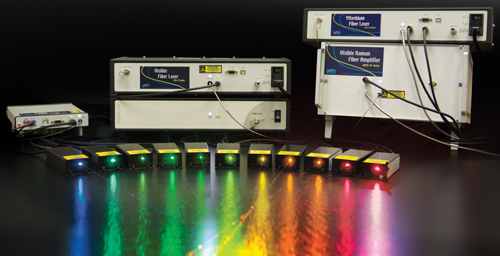
Semiconductor Lasers are lasers that use semiconductor materials as working materials. The excitation methods include electrical injection, electron beam excitation, and optical pumping. They are small in size, low in price, high in efficiency, long in service life, and low in power consumption. They can be used in electronic information, laser printing, laser pens, optical communications, laser televisions, small laser projectors, electronic information, integrated optics, and other fields. They are the most practical and important type of lasers.
Fiber Lasers refers to a laser that uses rare earth-doped glass fiber as the gain medium. It has a wide range of applications, including laser fiber communications, laser space long-distance communications, industrial shipbuilding, automobile manufacturing, laser engraving, laser marking, laser cutting, printing roller making, metal and non-metal drilling/cutting/welding (brass welding, quenching, cladding and deep welding), military defense security, medical equipment and instruments, large-scale infrastructure, as a pump source for other lasers, etc.
Free Electron Lasers is a new type of high-power coherent radiation source different from traditional lasers. It does not need gas, liquid or solid as working material, but directly converts the kinetic energy of high-energy electron beam into coherent radiation energy. Therefore, it can also be considered that the working material of free electron laser is free electrons. It has a series of excellent characteristics such as high power, high efficiency, wide range tuning of wavelength and time structure of ultra-short pulse. Except for it, no other laser can have these characteristics at the same time. It has very promising prospects in the fields of physics research, laser weapons, laser fusion, photochemistry, optical communications, etc.
JTBYShield is an enterprise focusing on the R&D and production of high-quality lasers, and is committed to providing customers with professional laser solutions to meet the needs of different industries for precision and efficiency. If you need laser products, please feel free to contact us!
1. Diversified product lines
JTBYShield offers a variety of lasers, including but not limited to solid lasers, fiber lasers, CO2 lasers, and semiconductor lasers, etc., to meet the needs of different customers.
Each laser undergoes strict quality control and performance testing to ensure its stability and reliability in various application environments.
2. High-quality products
Advanced manufacturing technology and high-quality materials are used to ensure that the laser has excellent beam quality and long life.
All products meet international standards and have passed ISO9001 quality management system certification.
3. High-quality service
Provide comprehensive pre-sales consultation and technical support to help customers choose the laser that best suits their application needs.
With a professional after-sales service team, it can quickly respond to customers' maintenance and repair needs to ensure the normal operation of the equipment.
4. Professional laser solutions
Provide customized laser solutions according to the specific needs of customers, including system integration, software development and training services.
Cooperate with many scientific research institutions and enterprises to continuously develop new technologies and improve product performance and service levels.
5. Wide range of application fields
The products are widely used in industrial processing, medical beauty, scientific research and education, military defense and other fields.
Especially in the fields of precision manufacturing and high-tech research, JTBYShield's lasers have won wide recognition for their excellent performance and stability.
Contact information:
If you have any ideas, feel free to talk to us. No matter where our customers are and what our requirements are, we will follow our goal to provide our customers with high quality, low prices, and the best service.
 Email:info@loshield.com
 Tel:0086-18092277517
 Fax: 86-29-81323155
 Wechat:0086-18092277517


