


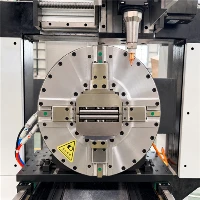
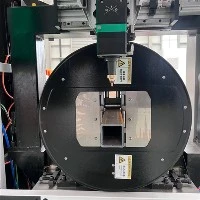
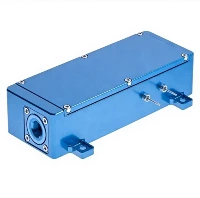
CO2 Laser is a gas laser that uses CO2 to generate laser radiation. It is one of the most widely used lasers at present. It has some very outstanding advantages such as high power and high quality. CO2 laser is currently a laser with higher continuous output power. It developed earlier and has relatively mature commercial products. It is widely used in various fields such as material processing, medical use, military weapons, and environmental measurement.

(1) High-power cross-flow CO2 laser
High-power cross-flow CO2 laser is used for laser processing and heat treatment. The whole laser machine is an integrated box. The upper box of the box is equipped with an integrated discharge chamber, heat exchanger, fan system, inlet and outlet guide and optical resonant cavity. The lower box of the box is equipped with a laser power supply, charging and deflating system, and vacuum pump. , ballast resistor box and control box. Compared with the existing technology, it has the characteristics of compact structure, convenient installation, debugging and maintenance, high laser working efficiency, and the size of the whole machine can be miniaturized. It is mainly used in welding applications such as diamond tools, automobile gears, automobile airbag gas generators, laser surface quenching and cladding processes, and its special applications in surface condensation quenching of steel rolls, surface repair of petrochemical parts, etc.
(2) Acousto-optically modulated QCO2 laser
In order to meet the application requirements in the fields of laser ranging, environmental detection, space communication, and research on the interaction mechanism between laser and matter, an acousto-optically modulated QC02 laser was developed. In view of the various factors affecting the output of the acousto-optic Q-switched CO2: laser, the Q-switched pulse laser rate equation was used to theoretically analyze and calculate the main technical parameters of the laser output, and a method for the optimization design of the acousto-optic Q-switched CO2: laser was proposed, and Validation experiments were conducted.
The laser pulse repetition frequency is 1Hz ~ 50kHz. The output laser pulse width obtained when operating at 1kHz is 180ns and the peak power is 4062W, which is basically consistent with the theoretical calculation. The results prove that: through the optimization of acousto-optic crystal (AO) and the reasonable design of the resonant cavity. It can achieve high repetition frequency, narrow pulse width, and high peak power output of small CO2 lasers, and can achieve wavelength tuning and encoding output of such lasers through the design of grating line selection and TTL signal control.
(3) Compact long-life radio frequency excitation waveguide CO2 laser
In order to make CO2 lasers more widely used in industrial processing and military applications, aluminum alloy drawn profiles are used as laser casings, disk-mounted inductors replace the structure of traditional wire-wound inductors, and all-metal sealing processes are used to develop a compact Type long-life RF-excited waveguide CO2 laser. It can output continuously or pulse output at a modulation frequency not higher than 20kHz, with a maximum output power of 30W, a measured working life of more than 1500h, and a storage life of more than 1.5a. The results show that this laser has compact structure, stable output power, long working life, With the characteristics of continuous and pulse modulation operation, it can not only meet the needs of processing various materials, but can also be used in military applications.
(4) New portable TEACO2 laser
It is a new type of portable transversely excited atmospheric pressure CO2 laser. The laser is powered by 4 AA rechargeable batteries and can work continuously for 1 hour at a repetition rate of 1Hz. The size of the complete laser machine (including power supply and control system) is 200nm × 200mm × 360mm, and the mass is less than 8kg. The laser uses ultraviolet electricity Halo pre-ionization method ensures uniform and stable discharge. Under free oscillation, the laser pulse output energy reaches 35mJ and the output pulse width is 70ns.
(5) High-power continuous CO2 laser
In order to solve the problems of cracks and blade deformation in continuous laser cladding of helicopter engine turbine blades, a new power control scheme was adopted on the 5kW continuous cross-flow CO2 laser, and pulsed laser power output was achieved through software and related control. Overcome the cost and stability problems caused by using high-power switching power supply. The pulse modulation frequency can reach 5Hz, and the modulation duty cycle can reach 5% to 100%. When using 4kW peak power, 4Hz pulse repetition frequency, and a duty cycle of 20%, the alloy powder StelliteX is carried out on the K403 surface of the engine blade. -40 cladding experiment. The results show that the heat-affected zone after cladding is 50% smaller than that of continuous laser, the hardness is increased by 5%, the interface bonding performance is equivalent to that of the base material, and there is no cladding crack or blade deformation.
Contact information:
If you have any ideas, feel free to talk to us. No matter where our customers are and what our requirements are, we will follow our goal to provide our customers with high quality, low prices, and the best service.
 Email:info@loshield.com
 Tel:0086-18092277517
 Fax: 86-29-81323155
 Wechat:0086-18092277517


