



Laser engraving modules can etch away copper on PCB boards.
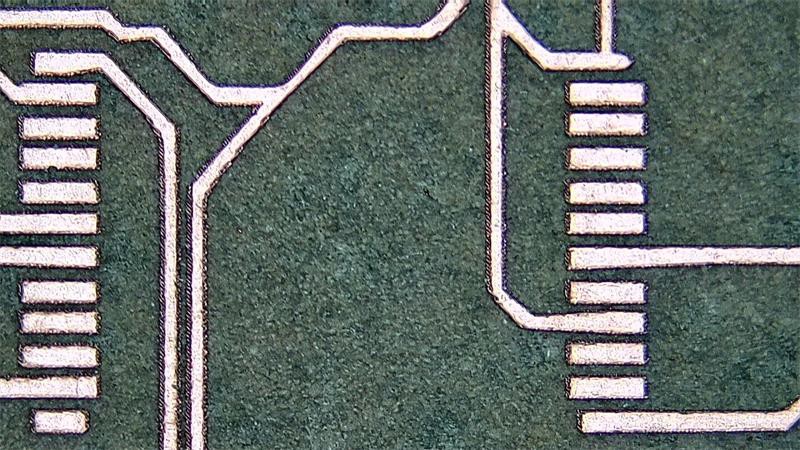
Laser engraving technology uses a high-energy-density laser beam to effectively remove copper materials from PCB boards by precisely controlling the laser's power, frequency, scanning speed and other parameters. This process usually involves repeated engraving to ensure that the copper layer is completely removed to form the desired circuit pattern. Although the method of directly using laser to engrave copper foil is relatively simple in terms of process, it may require repeated engraving, which increases processing time and may cause rough edges. In contrast, the method of combining three-proof paint and laser engraving not only increases speed, but also significantly improves the accuracy of the finished PCB.
Feasibility analysis of laser etching copper:
1. Physical and chemical properties of copper materials
Electrical conductivity and thermal conductivity: Copper is an excellent electrical and thermal conductive material, which makes it widely used in the electronics industry. High electrical conductivity and thermal conductivity mean that copper can quickly conduct current and heat, which is critical to PCB manufacturing.
Melting point and thermal conductivity: The melting point of copper is about 1083°C and the thermal conductivity is 401 W/(m·K). These properties indicate that copper can maintain its structural integrity at high temperatures while effectively dissipating heat.
Reflectivity: Copper has different reflectivities for light of different wavelengths. For example, for green light with a wavelength of 532nm, copper has a reflectivity of about 70%. This high reflectivity means that only a small portion of the laser energy is absorbed by copper, so a higher laser power is required to achieve effective etching.
2. Effect of laser on copper material
Energy absorption and heat-affected zone: When the laser beam is irradiated on the copper surface, copper absorbs part of the laser energy and converts it into heat energy. This causes the temperature of the copper surface to rise, thereby melting or vaporizing the copper material. However, due to the high reflectivity of copper, most of the laser energy will be reflected, so a higher laser power is required to achieve effective etching.
Etching depth and precision: Precise etching of copper materials can be achieved by precisely controlling laser parameters such as power, speed, and focus. Deeper etching depths can be achieved by increasing the laser power or reducing the scanning speed, but this may result in an expansion of the heat-affected zone and increased edge roughness.
Multiple repeated engraving: In order to completely remove the copper layer and form the desired circuit pattern, multiple repeated engravings may be required. Each engraving will deepen the etching depth and improve the edge quality. However, this will also increase processing time and cost.
3. Parameter control during etching process
Power: Laser power is one of the key factors affecting the etching effect. Higher laser power can increase the etching speed and depth, but it may also lead to an expansion of the heat-affected zone and an increase in edge roughness. Therefore, it is necessary to weigh the relationship between speed and accuracy when selecting laser power.
Speed: Scanning speed is also one of the important factors affecting the etching effect. Faster scanning speed can reduce the size of the heat-affected zone and edge roughness, but it may also reduce the etching depth and accuracy. Therefore, it is also necessary to weigh the relationship between speed and accuracy when selecting scanning speed.
Focus: The position of the laser focus also has an important influence on the etching effect. Setting the focus above the copper surface can obtain a smaller heat-affected zone and smoother edges; while setting the focus below the copper surface can obtain a deeper etching depth and higher accuracy. Therefore, when selecting the focus position, it is necessary to adjust it according to the specific application requirements.
Process flow of laser etching copper:
1. Design stage: pattern design and data preparation
Circuit diagram drawing: Use professional software such as Altium Designer or Eagle to draw a detailed circuit diagram. These software provide a wealth of tools to define the electrical connections and layout of the circuit board.
Convert file format: Convert the circuit diagram to a file format suitable for the laser engraving machine to read, usually a Gerber file. This format contains all the necessary manufacturing information, such as line width, hole position, etc.
Check and optimize: Perform a thorough check before conversion to ensure that there are no errors or omissions. Optimize the design to reduce material waste and improve production efficiency.
2. Preparation stage: PCB board fixing and positioning
Select the appropriate substrate: Select the appropriate type and thickness of substrate materials according to design requirements, such as FR4, ceramic, etc.
Clean surface: Make sure the surface of the PCB board is clean and dust-free to avoid affecting the laser etching effect.
Precise positioning: Use precision fixtures to fix the PCB board to ensure that it does not move during the laser engraving process.
3. Etching stage: Laser parameter setting and etching execution
Parameter setting: Adjust the laser power, speed and focus position according to the physical and chemical properties of copper. For example, higher power and slower speed may be required for thicker copper layers.
Trial engraving test: Perform a small-scale trial engraving before formal production to confirm whether the parameter settings are appropriate.
Continuous monitoring: Monitor the laser status and etching progress in real time during the etching process and make adjustments if necessary.
4. Post-processing stage: cleaning and inspection
Residue removal: Use appropriate solvents to clean the PCB board to remove copper chips and other residues caused by laser etching.
Visual inspection: Check each part of the PCB board through a magnifying glass or microscope to ensure that there are no open circuits, short circuits or other defects.
Functional testing: Electrically test the completed PCB board to verify whether it meets the design specifications.
In general, the entire laser etching copper process requires a high degree of precision and meticulous operation. Every link from design to final product must be strictly controlled to ensure the production of high-quality electronic products.
As an advanced manufacturing technology, laser etching copper has shown its unique advantages and challenges in the electronics industry.
1. Advantages
High precision and high efficiency
Laser etching can achieve extremely high precision, and the minimum line width can reach the micron level, which is especially important for high-density circuit boards. Compared with traditional chemical etching, laser etching can complete the production of complex patterns more quickly, significantly improving production efficiency.
Environmentally friendly, reducing the use of chemical etchants
Laser etching does not rely on harmful chemical etchants, reducing pollution to the environment and potential threats to human health. Since there is no involvement of chemicals, no harmful waste is generated during the laser etching process, which meets the requirements of green manufacturing.
High flexibility and adaptability to different design needs
Laser etching can easily cope with various complex design needs, including irregular shapes, fine patterns, etc. Through simple software adjustments, fast switching of different designs can be achieved, which improves the flexibility and response speed of production.
2. Challenges
High equipment cost
Laser etching equipment is usually expensive and may be a considerable investment for small and medium-sized enterprises. The maintenance and care of the equipment also requires professional technical support, which increases operating costs.
High requirements for operator skills
Laser etching technology requires operators to have certain professional knowledge and skills to ensure the stability of the production process and product quality. Training qualified operators may take a long time and high costs.
Possible heat-affected zone problems
Heat-affected zones may be generated during laser etching, resulting in reduced material properties or stress concentration. The scope and extent of the heat-affected zone need to be controlled by optimizing laser parameters and process conditions.
In general, while laser copper etching technology brings many advantages, it also faces some challenges. As the technology continues to develop and mature, I believe these challenges will gradually be overcome, and laser copper etching technology will be widely used in more fields.
Contact information:
If you have any ideas, feel free to talk to us. No matter where our customers are and what our requirements are, we will follow our goal to provide our customers with high quality, low prices, and the best service.
 Email:info@loshield.com
 Tel:0086-18092277517
 Fax: 86-29-81323155
 Wechat:0086-18092277517


