



The application of laser ranging modules in unmanned logistics vehicles is a key component for achieving automation and intelligence. It helps vehicles achieve autonomous navigation and obstacle avoidance in various environments by providing accurate distance measurement.
With the rapid development of science and technology, laser ranging technology has become an indispensable part of modern logistics development. This technology provides strong support for logistics safety, intelligent driving and intelligent logistics transportation with its high precision, high speed and high anti-interference.
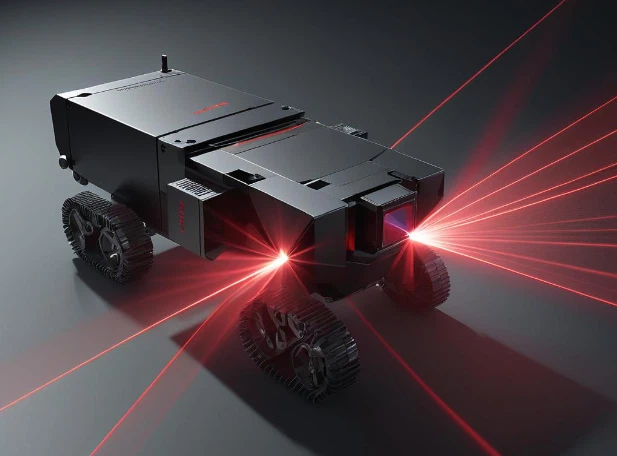
Laser ranging technology is a method of measuring distance using laser beams. It is widely used in various fields, from industrial production to scientific research.
1. Technical principle
Emission process: In the laser ranging process, a small and concentrated laser beam is first generated by the laser. These laser beams usually have high energy concentration and directionality, which enables them to maintain a small divergence over long distances.
Reflection process: The emitted laser beam is reflected after encountering the target object. The properties of the target object (such as surface material, color and shape) will affect the efficiency and quality of reflection. In many applications, the target object can be a specially set reflector to increase the number of beams reflected back to the laser rangefinder.
Detection process: The reflected laser beam is captured by the detector on the laser rangefinder (such as a photodiode or avalanche photodiode). The detector converts the received optical signal into an electrical signal, which is then digitized for further distance calculation.
2. Technical features
High accuracy: Laser ranging technology can provide extremely accurate measurement results. Since the speed of light is a known constant, combined with modern precision time measurement technology, laser ranging can achieve measurement accuracy at the millimeter or even smaller unit level.
High speed: Laser rangefinders can complete measurements in a very short time, which is particularly important for applications that require real-time data, such as dynamic measurement and robot navigation systems.
High anti-interference: The laser beam has strong directionality and high energy, is not easily affected by ambient light, and can maintain good measurement performance even in dusty and foggy environments. In addition, compared with other ranging technologies, laser ranging is less dependent on the material and color of the target object, which enhances its anti-interference ability.

These basic principles and characteristics of laser ranging technology make it an indispensable measurement tool in many fields, especially in situations where high precision and reliability are required. With the continuous advancement of technology, the performance of laser rangefinders will continue to improve and the application field will be further expanded.
Unmanned logistics vehicles play a key role in modern automated transportation systems, especially in factories, warehouses and other closed-loop environments. The efficiency and safety of these vehicles rely heavily on advanced laser ranging technology to address key needs such as autonomous navigation and obstacle avoidance.
1. Autonomous navigation
Environmental perception: Unmanned logistics vehicles use laser ranging technology for environmental perception, detecting surrounding objects and surfaces by emitting laser beams and receiving their reflections. This technology enables the vehicle to create an accurate three-dimensional map of the surrounding environment, including the location, shape and size of obstacles.
Spatial positioning: Laser ranging can help unmanned logistics vehicles determine their exact location in the environment by comparing with known reference points. Combined with the on-board computing system, unmanned vehicles can plan the best path based on this data and achieve autonomous navigation.
2. Obstacle avoidance requirements
Obstacle identification: In complex environments, unmanned logistics vehicles use laser rangefinders to continuously scan the area in front and around them to identify possible obstacles. These obstacles can be stationary objects (such as buildings and walls) or moving objects (such as people and other vehicles).
Obstacle avoidance strategy: Once an obstacle is identified, the navigation system of the unmanned logistics vehicle immediately recalculates the path to avoid the obstacle. The high-precision and high-update data provided by laser ranging technology enables unmanned vehicles to respond quickly, effectively avoid collisions, and maintain driving safety even in dynamically changing environments.
Faced with these needs and challenges, the development and operation teams of unmanned logistics vehicles must continuously optimize laser ranging technology and related algorithms to ensure that vehicles can reliably perform tasks under various conditions. With the continuous advancement of technology, unmanned logistics vehicles in the future will be able to achieve more efficient and safe automatic transportation in more complex and changing environments.

Application of laser ranging module
1. Environmental mapping
Map construction: Unmanned logistics vehicles use laser ranging modules to emit lasers to the surrounding environment and receive reflected signals. Based on the time difference or phase difference of these signals, the vehicle can calculate the precise location and distance of surrounding objects. Through continuous scanning, the vehicle can collect a large amount of point cloud data for building a two-dimensional or three-dimensional map of the environment.
Detail recognition: The laser ranging module can capture a variety of details, including the size, shape and texture of obstacles. Combined with advanced data processing algorithms, unmanned logistics vehicles can identify different types of objects, such as shelves, corridors, doors and other structures, to more accurately understand their operating environment.
2. Path Planning
Route Selection: Using the data provided by the laser ranging module, the path planning algorithm can calculate the optimal driving path for the unmanned logistics vehicle. This includes determining the starting point, target point, and checkpoints, while considering the safety, shortest and smoothness of the path.
Dynamic Adjustment: When environmental conditions change, such as when new obstacles appear or existing obstacles move, the laser ranging module can update environmental data in real time. The path planning system can quickly adjust the driving route based on this to ensure that the unmanned logistics vehicle can reach its destination safely and efficiently.
3. Real-time Obstacle Avoidance
Obstacle Detection: During driving, the unmanned logistics vehicle continuously uses the laser ranging module to scan the front and surrounding areas. Once any unforeseen obstacles such as people walking, other vehicles or unexpected objects are detected, the system will immediately evaluate them.
Obstacle Avoidance Response: Based on the high-precision data provided by the laser ranging module, the navigation system of the unmanned logistics vehicle can quickly calculate alternative paths and adjust the driving direction to avoid obstacles. This real-time obstacle avoidance capability greatly improves the operational safety and ability of the unmanned logistics vehicle to adapt to complex environments.
Advantages of laser ranging modules
1. Accuracy and efficiency
High-precision measurement: Compared with traditional ranging methods (such as ultrasonic or infrared ranging), laser ranging modules can provide higher measurement accuracy. This is because lasers can produce very fine beams, reducing measurement errors and can be accurate to the millimeter level or even smaller.
Improving efficiency: The laser ranging module has a fast response time and can complete a large number of distance measurements in a very short time, which is crucial for unmanned logistics vehicles that require quick decision-making and path planning. This high efficiency makes the laser ranging module a key factor in improving overall operational efficiency.
2. Flexibility and adaptability
Environmental adaptability: The laser ranging module performs well in different environmental conditions and can work stably both indoors and outdoors. Even in dusty, foggy or light-interfering environments, the laser ranging module can ensure reliable distance measurement through its high frequency and special signal processing technology.
Wide application: Due to its high flexibility, the laser ranging module can be applied to various types of unmanned logistics vehicles and can be adjusted to optimal performance in different industrial settings. This makes it very suitable for complex and changing operating environments.
3. Improved safety
Obstacle detection: The laser ranging module can promptly identify obstacles in the path and provide key obstacle avoidance information for the unmanned logistics vehicle. This capability greatly reduces the risk of collision or accident caused by failure to promptly identify obstacles.
Real-time data update: The real-time data update provided by the laser ranging module ensures that the unmanned logistics vehicle can dynamically adjust its driving strategy and respond to environmental changes, thereby increasing the continuity and safety of operation.
These laser ranging modules are widely used in two-dimensional laser radars. They have the characteristics of simple structure, fast ranging speed, stable and reliable system, and are suitable for environments with relatively simple terrain and smooth roads. However, when dealing with complex terrain and uneven roads, two-dimensional laser radars may not be able to complete the reconstruction of the terrain, and data distortion and false reporting are prone to occur. At this time, we can use three-dimensional laser radar to avoid this problem. It can accurately detect obstacles and construct a drivable area by obtaining depth information of the vehicle environment. Based on the rich point cloud data, we can obtain road elements including lanes, curbs, obstacles and drivable areas of unstructured roads, pedestrians and vehicles in the driving environment, traffic lights and traffic signs, and other rich information. Therefore, when we developed the laser ranging module, we fully considered the parameters such as laser power, wavelength and pulse width of the laser transmitter, as well as the response time and wavelength of the photodiode. These parameters directly affect the ranging accuracy, speed and range of the laser ranging module. In response to the application requirements of unmanned logistics vehicles, we can choose laser ranging modules with high precision, high response speed and high stability, and support enterprise customization.
JTBYShield Laser will always adhere to the principle of quality first and customer first, and use excellent product quality and efficient delivery capabilities to ensure customer purchase. If you are interested in our products, please contact us.
Contact information:
If you have any ideas, feel free to talk to us. No matter where our customers are and what our requirements are, we will follow our goal to provide our customers with high quality, low prices, and the best service.
 Email:info@loshield.com
 Tel:0086-18092277517
 Fax: 86-29-81323155
 Wechat:0086-18092277517


