


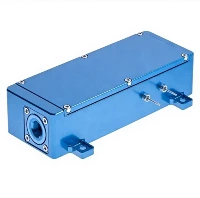
The application of Laser Modules in the field of autonomous driving is very extensive and important. One of the key technologies for driverless cars is environmental perception, and this is the main application area of lidar. Through environmental modeling using lidar, driverless cars can detect obstacles on the road and predict their movement trajectories to provide early warning or avoidance.
At the same time, lidar also plays an important role in vehicle positioning and navigation. It can help autonomous vehicles perform high-precision location positioning and path planning. In addition, based on SLAM (Simultaneous Localization and Mapping) technology, lidar can also assist in building accurate maps and performing real-time positioning.
In terms of vehicle control, laser modules can achieve precise control of autonomous vehicles through the acquired data. When an obstacle approaches, the laser module can issue a warning to improve driving safety.
However, although the application of laser modules in the field of autonomous driving has many advantages, such as high precision, strong real-time performance, and wide adaptability, it also faces some challenges, such as high cost, complex technology, and environmental impact. In particular, there are issues such as robustness in the face of different weather and harsh environments, accurate identification of distant objects, small sensor size, and control of mass production costs.
Application of laser modules in the field of driverless driving
A. Environment perception: Environmental modeling is performed through lidar to realize functions such as obstacle detection and distance measurement.
Laser modules are widely used in the field of autonomous driving, of which environmental perception is an important aspect. Environment modeling through lidar can realize functions such as obstacle detection and distance measurement. In addition, lidar can perform high-precision location positioning and path planning. Moreover, when an obstacle approaches, the laser module can issue a warning to improve driving safety.
Not only that, object detection is also one of the important applications of lidar. Before the rapid development of deep learning, clustering was commonly used for object detection, but it was difficult to separate dynamic and static objects. With the development of deep learning technology, point cloud object recognition also uses more deep learning.
B. Positioning and navigation: using lidar for high-precision positioning and path planning
Laser modules are very critical for positioning and navigation applications in the field of unmanned driving. It is capable of high-precision position positioning and path planning through lidar. Specifically, SLAM (Simultaneous Localization and Mapping) technology is currently the most stable and mainstream positioning and navigation method. In addition, lidar's precise detection and good anti-interference performance make it the "eyes" for robots to accurately perceive the environment, and through its "cerebellum" - positioning and navigation technology, it can achieve autonomous navigation, autonomous path planning and obstacle avoidance, etc. Complications.
C. Vehicle control: Precise control of autonomous vehicles is achieved through data obtained by lidar
Laser modules are very critical in vehicle control applications in the field of autonomous driving. It can achieve precise control of autonomous vehicles through the acquired data. For example, by scanning point clouds with LiDAR, driverless cars can accurately perceive the surrounding environment, including the location, shape, size and direction of movement of obstacles, etc., so as to make corresponding driving decisions.
In addition, lidar and other sensors complement each other and can effectively improve the accuracy of the vehicle's perception of the surrounding environment. This is very important in the field of autonomous driving, because accurate environmental perception is the basis for safe and effective driving.
D. Safety warning: When an obstacle approaches, the laser module can issue a warning to improve driving safety.
The safety warning application of laser modules in the field of driverless driving is very important. When an obstacle approaches, the laser module can issue a warning to improve driving safety. This is because lidar can accurately measure the distance between obstacles and vehicles by emitting laser beams and receiving reflected signals, thereby issuing timely warnings.
In addition, sensor hardware is the basis for autonomous driving and driving assistance systems, among which lidar is the most indispensable sensor for L4 and above autonomous driving. Unmanned vehicles also need to be equipped with sensors such as radar, cameras, and satellite positioning systems as redundancy to enhance safety.
The advantages of laser modules in the field of autonomous driving are mainly reflected in the following aspects:
First of all, it has the characteristics of high precision and strong real-time performance, and can quickly realize three-dimensional position positioning targets and accurately measure speed. Secondly, lidar has strong anti-interference ability and can work stably in various complex environments. In addition, lidar has a wide range of adaptability and can be used for both short-range, low-speed driving and long-distance, high-speed driving.
However, the application of laser modules in the field of autonomous driving also faces some challenges:
First, the cost of lidar is relatively high, which limits its promotion in large-scale commercial applications. Secondly, lidar technology is relatively complex and requires a lot of technical support and maintenance. In addition, environmental factors such as rain and snow may also affect the working effect of lidar. Therefore, future research and technical research need to focus on these issues to promote the development and evolution of the automotive lidar technology industry.
The development prospects in the field of autonomous driving are very broad, and laser modules, as an important sensor for autonomous driving, are also developing very rapidly. According to surveys, most companies currently focus on unmanned vehicles, robots and lidar in the field of unmanned vehicles as their main research directions.
The technical requirements and development status of vehicle-mounted lidar in application scenarios such as assisted driving and autonomous driving have been sorted out in detail. For example, Hesai Technology released its first lidar product Pandar40 in 2017, and deployed dedicated chip research and development in the same year; it launched a semi-solid + self-developed SoC lidar product PandarGT in 2019; and also launched a high-precision short-range laser in 2020 Radar layout in unmanned logistics and surveying and mapping fields.
However, it should be noted that although lidar has broad application prospects, its promotion in large-scale commercial applications still faces some challenges, such as high cost and technical complexity. Therefore, future research and technical research need to focus on these issues to promote the development and evolution of the automotive lidar technology industry.
Contact information:
If you have any ideas, feel free to talk to us. No matter where our customers are and what our requirements are, we will follow our goal to provide our customers with high quality, low prices, and the best service.
 Email:info@loshield.com
 Tel:0086-18092277517
 Fax: 86-29-81323155
 Wechat:0086-18092277517


