



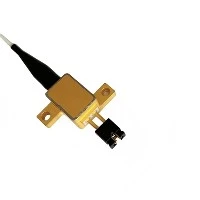
The introduction of the laser module as a core component for "visual guidance" and "precision positioning" is spearheading a quiet revolution in this crucial manufacturing step. This article explores how this non-contact technology is solving age-old problems and unlocking new possibilities in footwear assembly.

Core Technology: Deconstructing the Role of the Laser Module
In an intelligent button-attaching system, the laser module is not the tool that applies the force but the "guiding hand" that ensures the force is applied perfectly. Its roles are multifaceted:
Positioning Guidance:
How it Works: The laser module projects a high-visibility beam in a specific pattern (e.g., a crosshair, circle, dot matrix, or custom outline) directly onto the shoe upper. This pattern precisely marks the exact spot where the button, rivet, or decorative piece must be placed.
Technical Advantages:
High Precision: It eliminates human error from manual marking, achieving sub-millimeter accuracy for perfect alignment every time.
Visualization: The operator can intuitively see the target location, facilitating rapid material loading and final verification, creating a seamless human-machine interface.
Flexibility: Switching between different button styles is as simple as selecting a new pattern from the software-a "one-second mold change."
Alignment and Calibration:
Application Scenario: In fully automated production lines, the laser module works in concert with a machine vision system.
Workflow: A vision camera captures an image of the shoe upper and identifies predefined feature points -> The system's software calculates the theoretical attachment coordinates -> It commands the laser module to project the pattern onto the calculated position -> A robotic arm or pneumatic actuator then moves to the laser-marked spot to perform the riveting/attachment.
Value: This solves the problem of positional drift caused by last variations or material stretching, ensuring absolute consistency across every single shoe pair.
Quality Pre-Check and Error Prevention:
Application Method: By providing a clear, unambiguous "target" on the workpiece, the laser allows operators or vision systems to perform a final check before the physical attachment. This can catch issues like misplaced materials or incorrect components.
Value: It acts as a crucial fail-safe, drastically reducing scrap and rework rates by ensuring "right the first time" production.

Application Advantages: Multi-Dimensional Value Creation
The integration of laser modules translates into tangible benefits across the manufacturing process:
Enhanced Production Efficiency: Drastic reduction in machine downtime for mold changes and setup adjustments accelerates time-to-market for new designs. It also lowers the skill threshold for operators, simplifying training and reducing reliance on highly experienced staff.
Guaranteed Quality and Consistency: Batch-to-batch uniformity is achieved by eliminating manual marking variances. The non-contact nature of the guidance prevents surface damage to sensitive materials, preserving the premium quality and aesthetic appeal of the final product, thereby enhancing brand value.
Increased Flexibility and Intelligence: Laser-guided systems easily integrate with Manufacturing Execution Systems (MES) or Enterprise Resource Planning (ERP) software. Order parameters, including button type and precise coordinates, can be automatically downloaded, making small-batch and Made-to-Order (M2C) production economically viable. This is a foundational step towards "Industry 4.0" in footwear manufacturing.
Reduced Total Cost of Ownership (TCO): The significant decrease in scrap rates and material waste directly lowers costs. Furthermore, manufacturers save substantially on the cost of manufacturing, storing, and managing a vast inventory of physical dies and punches. The overall improvement in equipment utilization leads to a higher return on investment.
Technical Selection and Implementation Considerations
Successfully implementing this technology requires careful consideration:
Key Parameters for Laser Module Selection:
Wavelength: Red lasers (650nm) are common and cost-effective. Green lasers (520nm) offer superior visibility and contrast on dark-colored materials like black leather.
Power: Low-power (Class II or below) modules are standard, ensuring operational safety for personnel.
Line Pattern and Shape: The pattern must match the component-crosshairs for precise points, circles for rivets, or custom outlines for complex shapes.
Accuracy and Stability: The module's inherent positional accuracy and its thermal stability during prolonged operation are critical for long-term performance.
System Integration Essentials:
Mechanical Installation: The module must be mounted securely with anti-vibration and dust-proofing measures to maintain a stable optical path.
Electrical Interface: Compatibility with the machine's PLC or industrial PC is crucial, whether via simple I/O control, RS232, or Ethernet communication.
Software Control: User-friendly software is needed for easy pattern selection, fine-tuning of coordinates, and saving/recalling recipes for different shoe models.
Safety and Maintenance:
Safety Compliance: Equipment must adhere to laser safety standards (e.g., IEC 60825), with clear warning labels and protective housings to prevent accidental exposure.
Routine Maintenance: Keeping the output lens clean is essential to maintain a sharp, clear projection.
Future Outlook and Development Trends
The evolution of laser guidance in shoemaking is poised to continue:
Deeper Integration with AI: Machine vision powered by AI will not only locate positions but also identify material defects and automatically adjust attachment points or flag the component for rejection.
Fusion with Augmented Reality (AR): AR glasses could project assembly instructions and laser guidance directly into the operator's field of view, providing a more immersive and information-rich working environment.
Higher Precision and Miniaturization: Laser modules will become smaller and more integrated, enabling their use on more intricate shoe designs and delicate accessories.
Standardization and Platformization: The development of industry-wide communication standards for laser positioning systems will accelerate adoption and simplify integration across different machinery brands.
Conclusion
The laser module represents a paradigm shift for button-attaching machinery, moving the industry from "hard tooling" to "soft guidance." This technology is more than an incremental improvement; it is a strategic enabler that enhances the core competitiveness of the footwear industry. By ensuring precision, enabling flexibility, and reducing waste, laser guidance is a cornerstone in the journey toward advanced, intelligent manufacturing. As the "guiding eye" of industrial automation, the laser module will continue to drive footwear production towards a smarter, more adaptable, and more efficient future.
Contact information:
If you have any ideas, feel free to talk to us. No matter where our customers are and what our requirements are, we will follow our goal to provide our customers with high quality, low prices, and the best service.
 Email:info@loshield.com; laser@loshield.com
 Tel:0086-18092277517; 0086-17392801246
 Fax: 86-29-81323155
 Wechat:0086-18092277517; 0086-17392801246


