



532nm laser module and 520nm laser module are two common green lasers. Green lasers are like a bright pearl, playing an irreplaceable role in many fields with their unique wavelength and superior performance. 532nm and 520nm lasers are similar in visibility, but have their own advantages in technical details and applications.
The important role of green lasers in modern science and technology cannot be ignored. Its unique wavelength not only makes green light one of the most sensitive colors for the human eye, but also shows excellent performance in many fields. Green lasers are widely used in the medical field, such as iridotomy and phacoemulsification in ophthalmic surgery. Since green light causes minimal damage to the eyes and has strong penetrating power, it has become an ideal choice in the medical field. At the same time, in measurement and control systems, green lasers are also favored for their high precision and stability. In the fields of stage performances, night scene lighting and military, green lasers also show their unique charm.
Comparison of technical principles between 532nm and 520nm laser modules
1. 532nm laser module
Technical principle
The 532nm laser module is based on diode pumped solid (DPSS) technology, which converts 1064nm infrared laser into 532nm green light through frequency doubling. Commonly used semiconductor materials include gallium nitride and aluminum gallium arsenide, which stimulate electron transitions under specific currents, generate photons and form stable laser beams.
Semiconductor materials used
The 532nm laser module mainly uses semiconductor materials such as gallium nitride and aluminum gallium arsenide. These materials have energy level structures suitable for generating green lasers. By applying appropriate currents, the internal electrons undergo energy level transitions and release photons, thereby forming a high-brightness and high-efficiency green laser beam.
Green light output through frequency doubling technology
The 532nm laser module uses frequency doubling technology to convert 1064nm wavelength infrared laser into 532nm green light through nonlinear optical crystals. This technology ensures the efficient conversion and stability of the laser, making it widely used in industrial processing, medical beauty and scientific research.

2. 520nm laser module
Technical principle
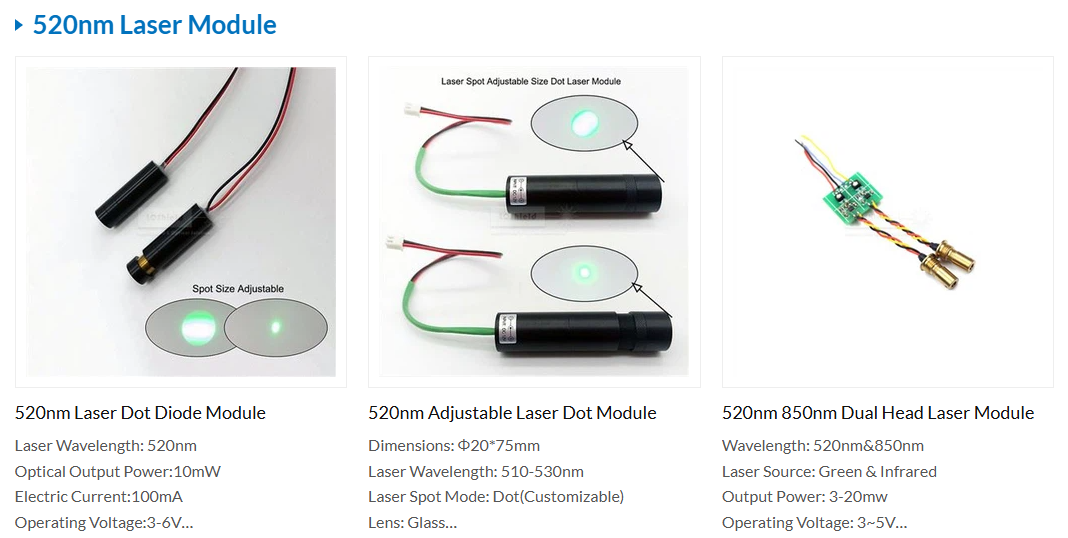
The 520nm laser module is based on direct semiconductor laser technology. It uses semiconductor materials such as indium phosphide to stimulate electron transitions through current and directly emit green light with a wavelength of 520nm. Its light-emitting process is simple and direct, suitable for low-power and miniaturized application scenarios.
Semiconductor materials used
The 520nm laser module mainly uses indium phosphide as a semiconductor material. This material has good electro-optical conversion efficiency and stability, and can achieve efficient green light emission at a lower current, which is suitable for portable devices and low-energy applications.
Luminescence characteristics based on direct semiconductor laser technology
The 520nm laser module uses direct semiconductor laser technology to inject current to make electrons transition from the valence band to the conduction band, and directly emits green light with a wavelength of 520nm. This technology has the characteristics of simple structure, small size, and easy integration, and is widely used in stage performances, night scene lighting and other fields.
Comparison of lifespan between 532nm and 520nm laser modules
1. Lifespan of 532nm laser module
532nm lasers usually use high-quality semiconductor materials such as gallium nitride and aluminum gallium arsenide, which perform well at high power. Its lifespan is generally around 10,000 hours, depending on the use environment and operating conditions.
2. Lifespan of 520nm laser module
520nm lasers mainly use semiconductor materials such as indium phosphide, which have good stability and durability. In typical applications, the lifespan of 520nm lasers is usually between 8,000 and 12,000 hours, which is suitable for long-term use.
3. Lifespan comparison and influencing factors
Due to its higher output power and complex frequency doubling technology, 532nm lasers usually perform better in high-power application scenarios. 520nm lasers, on the other hand, are suitable for low-power and portable devices due to their direct semiconductor light-emitting characteristics. The difference in lifespan between the two is mainly affected by materials, design, and working environment.
Comparison of application fields between 532nm and 520nm laser modules
1. Industrial processing
532nm laser module: 532nm laser module is widely used in micro-processing fields with high precision requirements such as glass marking and thin film etching. Its high energy density and fine beam quality make it perform well in these applications.
520nm laser module: 520nm laser module is usually not used in traditional industrial processing, but it is used in some special optical measurement and detection equipment.
2. Scientific research field
532nm laser module: 532nm laser module is often used in experiments such as spectral analysis, laser detection and laser measurement due to its high brightness and penetration. It is suitable for scientific research work that requires precise control of laser energy and wavelength.
520nm laser module: 520nm laser module can be used in optical biosensing, fluorescence detection and other fields, with the advantages of high sensitivity and high resolution.
3. Medical cosmetology
532nm laser module: 532nm laser module has good results in ophthalmic treatment, such as the treatment of glaucoma and maculopathy, and is also used in medical cosmetology.
520nm laser module: 520nm laser module is mainly used for medical cosmetology applications in the sub-health field, such as laser beauty, skin care, etc.
4. Stage lighting
532nm laser module: 532nm laser module is less used in stage lighting, and is more focused on industrial and scientific research purposes.
520nm laser module: 520nm laser module is used as a light source in indoor demonstrations and small stage performances, providing high stability and high-quality lighting effects.
In general, 532nm laser modules focus more on applications in industrial processing and scientific research, while 520nm laser modules are more common in indoor demonstrations, small stage performances, and medical cosmetology applications in the sub-health field. When choosing a laser module, you should decide which wavelength of laser module to use based on the specific application requirements.
The 532nm laser module has the advantages of high brightness, high efficiency and strong stability. Its wavelength is close to the 555nm green light that the human eye is most sensitive to, so under the same power conditions, its visibility is slightly higher than that of the 520nm laser. In addition, the 532nm laser module adopts frequency doubling technology (DPSS), which has significant advantages in compactness and efficiency, and is widely used in scientific research, industrial processing and other fields. However, the cost of 532nm lasers is relatively high, and may not be as suitable as lasers of other wavelengths in certain specific applications.
The 520nm laser module is known for its high efficiency and energy stability. It is based on semiconductor laser technology, and its color is light green close to forest green, which is suitable for close-range application scenarios such as indoor small stage performances. In addition, the 520nm laser is different from the 532nm laser in color, but the performance of the two is comparable under the same power. However, the visibility of the 520nm laser is slightly lower than that of the 532nm laser, especially when propagating over long distances. At the same time, due to the limitation of its specific wavelength, the application field of the 520nm laser is relatively limited.
When choosing a laser, the following factors should be fully considered:
Application field: clarify which field the laser will be used in, such as scientific research, industrial processing, medical treatment, entertainment, etc.
Visibility requirements: If high visibility is required, especially for long-distance transmission or outdoor use, 532nm lasers may be a better choice.
Cost considerations: Choose the right laser type according to your budget to ensure the best cost-effectiveness.
Stability and efficiency: For applications that require long-term stable operation, lasers with high stability and high efficiency should be selected.
Specific wavelength requirements: Some applications may require lasers of specific wavelengths, and at this time, they should be selected according to specific needs.
532nm and 520nm laser modules each have their own unique advantages and disadvantages. When choosing, factors such as application field, visibility requirements, cost, stability and efficiency, and specific wavelength requirements should be considered comprehensively.
JTBYShield Laser Technology Co., Ltd. provides different application fields of laser equipment parts and laser safety, including parts of various laser supplies, laser diodes, laser modules, laser engraving modules, fiber lasers, DPSS lasers, laser safety glasses, laser safety window, etc. It involves many types and is comprehensive.
We have a team with strong creativity, technology, and proficiency in laser module products, are able to provide you with exclusive customized products according to your requirements and can provide different fields, and customers, with the best solutions.
If you are interested, please contact us in time and we will send you more product details and specific quotation.
Contact information:
If you have any ideas, feel free to talk to us. No matter where our customers are and what our requirements are, we will follow our goal to provide our customers with high quality, low prices, and the best service.
 Email:info@loshield.com
 Tel:0086-18092277517
 Fax: 86-29-81323155
 Wechat:0086-18092277517


