




Since the invention of the first Semiconductor Lasers in the world in 1962, the semiconductor laser has undergone great changes, greatly promoting the development of other science and technology, and is regarded as one of the important inventions of the 20th century. In recent decades, the development of semiconductor laser is more rapid and has become the world's fastest-developing laser technology. The application of semiconductor lasers covers the whole field of optoelectronics and has become the core technology of optoelectronics science. Due to the advantages of small size, simple structure, low input energy, long life, ease to modulate, and low price, the semiconductor laser has been widely used in the field of optoelectronics and has been highly valued by countries around the world.

1. Semiconductor lasers
The semiconductor laser is a kind of miniaturized laser that is composed of a Pn junction or Pin of direct band gap semiconductor material. There are dozens of kinds of semiconductor laser-working substances. At present, the semiconductor materials that have been made into lasers are gallium arsenide, indium arsenide, indium antimonide, cadmium sulfide, cadmium telluride, lead selenide, lead telluride, aluminum gallium arsenic, indium phosphorus arsenic and so on. There are three kinds of excitation modes of a semiconductor laser, namely, electric injection, optical pump, and high-energy electron beam excitation. The excitation mode of most semiconductor lasers is electric injection, that is, forward voltage is applied to the Pn junction to generate stimulated emission in the junction plane region, that is, it is a forward-biased diode. Therefore, the semiconductor laser is also called the semiconductor laser diode. For semiconductors, since electrons transition between energy bands rather than between discrete energy levels, the transition energy is not a definite value, which makes the output wavelength of the semiconductor laser spread over a wide range. They emit wavelengths ranging from 0.3 to 34μm. The wavelength range depends on the band gap of the material used. The common AlGaAs double heterojunction laser has an output wavelength of 750 ~ 890nm.
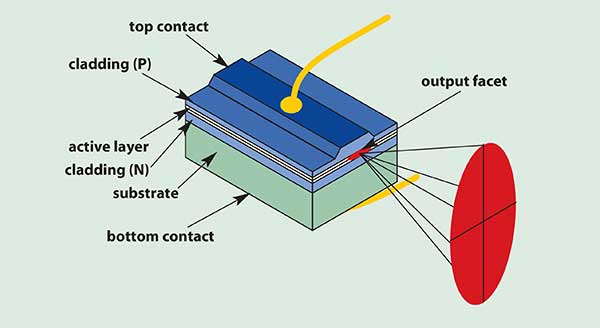
Semiconductor lasers production technology has experienced from the diffusion method to liquid phase epitaxy (LPE), gas phase epitaxy (VPE), molecular beam epitaxy (MBE), MOCVD method (organic metal vapor deposition), chemical beam epitaxy (CBE) and their various combination of a variety of processes. The disadvantage of the semiconductor laser is that the laser performance is affected by temperature, and the divergence Angle of the beam is large (generally between several degrees and 20 degrees), so it is poor in directivity, monochromatic property, and coherence. But with the rapid development of science and technology, the research of dpss lasers is advancing in the direction of depth, and the performance of semiconductor laser is constantly improving. Semiconductor optoelectronics technology with semiconductor laser as the core will make greater progress and play a greater role in the information society of the 21st century.
2. Working principle of semiconductor lasers
The semiconductor laser is a coherent radiation source. Three basic conditions must be met in order to generate a laser.
①Gain condition: the inversion distribution of charge carriers in the excitation medium (active region) is established. In semiconductors, the energy of electrons is represented by a series of nearly continuous energy levels. This is achieved by applying a forward bias to the homogeneous or heterojunction and injecting the necessary charge carriers into the active layer to excite electrons from the lower valence band to the higher conduction band. Stimulated emission occurs when a large number of electrons in the reversed particle population state recombine with holes.
②to actually obtain coherent excited radiation, one must make the excited radiation in the optical resonator to get multiple feedback and form laser oscillation, the resonator of the laser is formed by the natural cleavage surface of the semiconductor crystal as a mirror, usually in the end of the light plating on the high inverse multilayer dielectric film, and the smooth surface plating on the reduced inverse film. For the F-p cavity (Fabry-Perot cavity) semiconductor laser, the F-P cavity can be conveniently constructed by the natural cleavage plane perpendicular to the p-n junction plane of the crystal.
③In order to form stable oscillation, the laser medium must be able to provide sufficient gain to make up for the optical loss caused by the resonant cavity and the laser output from the surface of the cavity, and constantly increase the optical field in the cavity. This requires a strong enough current injection, that is, enough particle number inversion. The higher the degree of particle number inversion, the greater the gain, that is, a certain current threshold condition must be met. When the laser reaches the threshold, light with a specific wavelength can resonate in the cavity and be amplified, and finally form a laser and output continuously. It can be seen that the dipole transition of electron and hole is the basic process of light emission and light amplification in semiconductor lasers. For the new semiconductor laser, it is generally accepted that quantum well is the fundamental driving force for the development of lasers. The e question of whether quantum wires and dots can take full advantage of quantum effects has extended well into this century. Scientists have experimented with self-organizing structures to make quantum dots in various materials, and GaInN quantum dots have been used in semiconductor lasers.

Transfer to partⅡ understands its history and application
Contact information:
If you have any ideas, feel free to talk to us. No matter where our customers are and what our requirements are, we will follow our goal to provide our customers with high quality, low prices, and the best service.
 Email:info@loshield.com
 Tel:0086-18092277517
 Fax: 86-29-81323155
 Wechat:0086-18092277517


