



With the increasing popularity of laser technology, laser protective glasses are an important tool to protect the eyes from laser radiation damage. Their performance parameters and selection criteria have become the focus of users. Especially when facing lasers of specific wavelengths, such as 1064nm, choosing suitable laser protective glasses is particularly critical.
1. The importance of laser protective glasses
Laser protective glasses are protective equipment designed to protect the eyes from laser radiation damage. They effectively filter and attenuate laser radiation through specific optical designs, such as optical density (OD) and laser mode (LB) levels, thereby protecting the eyes from damage. In the fields of laser processing, medical surgery, scientific research experiments, etc., workers often need to face the laser directly. The use of laser protective glasses not only improves work safety, but also ensures production efficiency and quality. Therefore, choosing suitable laser protective glasses is crucial to protecting the health and safety of operators.

2. Definition and characteristics of 1064nm OD6+ and 1064nm LB6+ laser protective glasses
- 1064nm OD6+ laser protective glasses
OD value (Optical Density) is an important parameter to measure the protection ability of laser protective glasses against lasers of specific wavelengths. OD6+ means that the optical density of the lens is at least 6, usually in integers, and the plus sign behind it means that there may be a decimal part, but not more than 0.9. This means that 1064nm OD6+ laser protective glasses can effectively reduce at least 99.9999% of 1064nm laser radiation. This high-protection level of glasses is suitable for a variety of laser working modes, including continuous wave and pulse wave.

- 1064nm LB6+ laser protective glasses
LB value (Laser Beam) is another parameter used to measure the protection ability of laser protective glasses. LB6+ means that the lens can withstand 1064nm laser radiation with a maximum power density or energy density level of 6. This marking method is mainly for continuous wave or long pulse time modes, such as D (continuous) or I (intermittent) mode lasers. The specific requirements of LB6+ may vary depending on different manufacturers and product models, but generally provide high protection capabilities.
- Can 1064nm OD6+ and 1064nm LB6+ appear on a pair of glasses at the same time?
1064nm OD6+ and 1064nm LB6+ glasses can appear on a pair of glasses at the same time. This design is not only technically feasible, but also versatile and user-friendly in practical applications. There are related products on the market, and professional manufacturers (such as JTBYShield Laser Technology Co., Ltd.) provide customized services to meet the personalized needs of different users. Therefore, for users who need to face multiple laser environments at the same time, it is a wise choice to choose a pair of glasses with both OD6+ and LB6+ protection capabilities.
3. Scope of application of 1064nm OD6+ and 1064nm LB6+ laser protective glasses
- 1064nm OD6+ laser protective glasses
Due to its high OD value, 1064nm OD6+ laser protective glasses are suitable for various laser working environments, especially those that require long-term exposure to high-intensity laser radiation. Whether it is industrial processing, medical surgery or scientific research experiments, as long as it involves the application of 1064nm laser, this pair of glasses can provide effective protection.
- 1064nm LB6+ laser protective glasses
LB6+'s marking method focuses more on continuous wave or long pulse time modes, so it is particularly suitable for working environments that use D (continuous) or I (intermittent) mode lasers. In these cases, LB6+ glasses can ensure that the operator's eyes are not harmed by laser radiation.
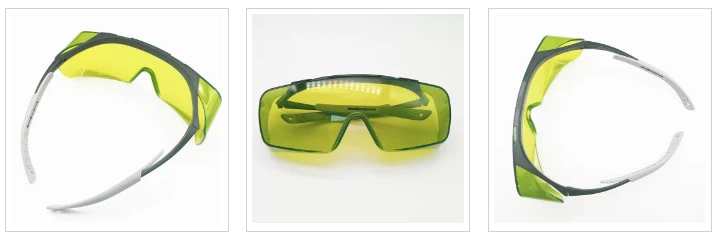
4. How to choose suitable laser protective glasses
When choosing laser protective glasses, in addition to considering OD and LB values, you also need to pay attention to the following points:
- Visible light transmittance (VLT): Visible light transmittance refers to the percentage of visible light allowed to pass through the eyeglass lens. Too high VLT may lead to increased internal reflection of glasses and reduce the protective effect; while too low VLT may affect the wearer's visual comfort and work efficiency. Therefore, when choosing, you should choose the appropriate VLT value according to your needs and working environment.
- Lens material: The lens material directly affects the durability and comfort of glasses. Common lens materials include polycarbonate, glass and plastic. Among them, polycarbonate lenses have the advantages of light weight and good impact resistance, and are commonly used materials for making laser protective glasses.
- Comfort: Comfort is one of the important factors that affect whether the wearer is willing to wear it for a long time. When choosing, you should pay attention to whether the weight of the glasses, the degree of clamping of the nose bridge, the length of the temples, etc. meet your needs.
- Certification standards: Make sure that the selected laser protective glasses meet the relevant safety standards and certification requirements to ensure their protective effect and reliable quality.
In summary, 1064nm OD6+ and 1064nm LB6+ laser protective glasses are both efficient protective tools designed for laser radiation of specific wavelengths. When choosing, you should consider various factors according to your actual needs and working environment to ensure that you buy safe and comfortable laser protective glasses. At the same time, you should also pay attention to regular inspection and replacement of glasses to maintain their good protective effect.