



The Laser Module used in different applications are different, so we need to understand the parameters of the laser, which directly determines the user's choice of laser light source. Now many fields are inseparable from the application of laser, especially in production, scientific research, medicine and other fields. This article sorts out some parameters of conventional lasers and gives a simple explanation, hoping to help you find the right laser product.
1. Laser Module Output Power
The light emitted by Lasers comes in the form of light energy, which, like electrical energy, is an energy source. Similar to the output power of a generator, the output power of a laser is a physical quantity that measures the output of laser energy per unit of time. Common units are milliwatts (mW), watts (W), and kilowatts (kW).

2. Laser Module Power Stability
Power stability represents the instability of laser output power in a certain period of time, which is generally divided into RMS stability and peak-to-peak stability.
RMS stability: The ratio of the root mean square of all sampled power values to the average power value during the test time, describing the dispersion degree of the output power from the average power value. Peak-to-peak stability: maximum and minimum output power
The percentage of the difference between the values and the average power value represents the variation range of the output power within a certain time.
3. Beam Quality Factor (M² factor); Beam Parameter Product (BPP)
The beam quality factor is defined as the ratio of the product of the waist radius of the laser beam and the far-field divergence Angle of the beam to the product of the waist radius of the ideal fundamental mode beam and the divergence Angle of the ideal fundamental mode, that is, M2=θw/θ ideal w ideal. The beam quality will affect the focusing effect of the laser and the far-field spot distribution, which is used to characterize the quality of the laser beam. The closer the actual beam quality factor is to 1, the closer the beam quality is to the ideal beam, and the better the beam quality will be. Beam shapers generally require a high-quality laser with an M2 of less than 1.5.
The beam parameter product (BPP) is defined as the product of the far-field divergence Angle of the laser beam and the radius of the narrowest point of the beam, i.e. BPP=θw. It can quantify the mass of the laser beam and the degree to which the laser beam is focused to a small point. The lower the beam parameter product is, the better the beam quality is. The relationship between the BPP value and M² value is: M² value is the normalized value of BPP value, for the diffraction limit beam with a specific wavelength normalization, that is, M²=BPP/BPP0, BPP0 is the value of the diffraction limit beam of a specific wavelength, and BPP0=λ/π.
4. Laser Module Spot (transverse mode)
Transverse mode is defined as the distribution of a stable field on a cross-section perpendicular to the direction of laser propagation. The laser spot characterization is the transverse mode distribution. The transverse mode distribution can be simulated by a spot analyzer or laser profile analyzer to obtain some beam characteristics of the laser. Common transverse mode modes include basic transverse mode (TEM), TEM, TEM, etc., as well as other modes as shown in Figure 1. TEM mode refers to a point with a light intensity of 0 on the section in the x direction, and TEM mode refers to a point with a light intensity of 0 on the section in both the x and y directions.

5. Laser Module Laser Beam Diameter
The measuring methods of laser beam diameter include a hole-hole method, laser beam analyzer (CCD) measurement, knife edge method, etc.
Hole method: This method is generally not used, because it is difficult to make the hole and the beam concentric in the experiment, and the accuracy of the experimental results cannot be guaranteed.
Laser profile analyzer (CCD) test: The accuracy of test results can be guaranteed. The results of four calculation methods for laser beam diameter are presented in the software interface (as shown in Figure 2). The most commonly used definition method is 13.5% (1/e²) of the peak value. But this method also has some defects, for high power laser, the CCD saturation phenomenon, such as using an attenuator, may cause beam deformity.
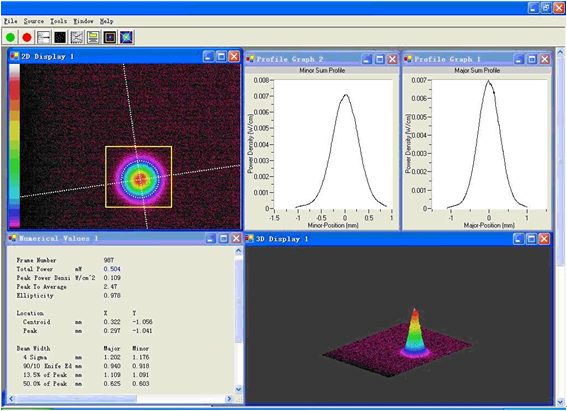
The Knife-edge method is an ideal method for measuring the diameter of the laser beam of high-power laser. Take laser under test through the blade edge light power 10% of the total power edge position coordinates of x, take laser under test through the blade edge light power 90% of the total power edge position coordinates of x, can measure the laser beam diameter = 1.561 x | | x - x (including 1.561 is fitting values).
The reason why we use a ruler or human eye to measure the diameter of the laser beam of visible light is larger than that measured by a professional laser profile analyzer, is because the laser energy is strong and concentrated, and there will be a certain divergence when the laser acts on the object. However, the laser beam diameter at the peak intensity (13.5%) is commonly used as the measurement result when the laser profile analyzer is used to measure. So the result will be relatively small.
6. Diffraction limit
An object point passing through an optical system can obtain an ideal image under ideal conditions, but it is actually impossible to form. Due to the limitation of diffraction, this object point can obtain a Fraunhofer diffraction image. The potential of focusing the laser beam to a small point under a certain wavelength is as high as possible, that is, the laser beam quality is ideal, and this is the diffraction limit. The aperture of common light is circular, so the Fraunhofer diffraction image formed is an Airy spot, in this case, the image formed by each object point is a diffuse spot, when the two spots close to it is difficult to distinguish, so limiting the resolution of the optical system, and the bigger the spot the lower the resolution, this is the diffraction of light caused by the limitations of physical optics.
For the laser beam, the diffraction limit spot diameter formula: is d=4LλM²/πD, where L is the working distance, λ is the wavelength of the laser beam, M² is the quality factor of the laser beam, and D is the diameter of the laser beam.
7. Laser modulation
Laser modulation is the use of light as a carrier, the signal load on the light, according to the application requirements, and the signal transmission. General modulation is divided into external modulation and internal modulation, external modulation refers to the laser external mechanical modulation or acoustic-optic modulation, internal modulation refers to power-driven modulation and internal modulation is divided into TTL modulation and analog modulation.
TTL modulation: When the high and low level (0V or 5V) DC signal of a certain frequency is input to the laser externally, the light is closed at the low level, and the high-level amplitude is not adjustable at the high level.
Analog modulation: The waveform and amplitude of the input signal can be adjusted freely. The laser output power changes linearly with the input analog voltage signal.
Contact information:
If you have any ideas, feel free to talk to us. No matter where our customers are and what our requirements are, we will follow our goal to provide our customers with high quality, low prices, and the best service.
 Email:info@loshield.com
 Tel:0086-18092277517
 Fax: 86-29-81323155
 Wechat:0086-18092277517


