



Although there are a variety of lasers, they are generated by excitation and stimulated radiation, so the basic composition of the laser is fixed, by the working substance (that is, the working medium that can produce a particle number inversion after excitation), the excitation source (energy that can make the working substance a particle number inversion, also known as the pump source), and the optical resonator are composed of three parts.

Ⅱ. Gas laser
There are many types of gas lasers, the most commonly used of which are carbon dioxide lasers and helium-neon lasers.
1. CO₂ laser generator
CO₂ laser, mainly uses CO₂ gas, adds a small amount of nitrogen and helium, and also uses the "pump source" excitation, so that the gas molecules produce energy level transition, thereby stimulating the laser.
CO₂ laser excited molecular energy levels to obtain laser, Its working principle is more complex because the molecule has three different movements, one is the movement of electrons in the molecule determines the electron state of the molecule; Second, the vibrational energy state of the molecule is determined by the atomic vibration in the molecule. Third, the overall rotation of the molecule determines the rotational energy state of the molecule. The state of molecular motion is complex, the energy level is complex, so the energy level transition process of excited molecules is also complex.
The gas CO₂, small amounts of nitrogen and helium are encapsulated in a glass "discharge tube"; Some sort of "pump source" is continuously applied, which emits electrons that hit nitrogen molecules in the tube and cause them to be excited; Nitrogen molecules and CO₂ molecules collide, nitrogen molecules transfer energy to CO₂ molecules, CO₂ molecules transition from low energy level to high energy level; Send out a laser. That is to say, the "pump source" of the laser emitted by the CO₂ gas molecule is a secondary excitation, first the electron-excited nitrogen molecule vibration, and then the nitrogen molecule impinging on the CO₂ molecule.
CO₂ molecules are excited out of infrared light but also need to strengthen the resonance, and the enhanced laser must be transmitted out. In order to strengthen the infrared resonance, the sealed glass tube can be gold-plated to form a mirror; Since the general glass is not able to pass infrared light, a small hole is opened in the middle of the mirror and a material that can pass infrared light is sealed, so that the infrared laser after resonance can be transmitted through the hole.
CO₂ laser excitation source has a variety of high voltage direct current, high frequency alternating current, radio frequency, and microwave can.
Commonly used CO₂ lasers range in power from tens of watts to nearly kilowatts, CO₂ lasers are sold on the market, and these lasers are successfully used in all walks of life. These properties make carbon dioxide lasers widely used in many fields. In industry, it is used for processing a variety of materials, including drilling, cutting, welding, annealing, fusion, surface modification, coating, etc. Medically used in various surgical procedures; Military applications include laser ranging, lidar, and even directed energy weapons.
2. Helium-neon laser
Helium-neon laser is one of the most widely used lasers at present, with an output power between 0.5 and 100 milliwatts, with very good beam quality, It can be used in surgical treatment, laser cosmetology, building measurement, collimation indication, photocoped printing, laser gyro, etc. Many high school LABS are also using it for demonstration experiments.
In general, the output energy density of gas lasers is smaller than that of solid lasers.
Ⅲ. Semiconductor laser
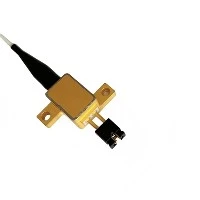
At present, in semiconductor laser devices, GaAs (Gallium arsenide) diode semiconductor laser has better performance and is widely used.
For GaAs (Gallium arsenide) lasers, the number of non-equilibrium carriers is reversed between the energy bands of semiconductor materials by means of current excitation, and the laser is generated when the electrons in the reversed state are combined with holes.
Semiconductor diode lasers can emit visible laser light but also can emit near-infrared or ultraviolet light. It is worth noting that the light emitted by the ordinary light-emitting diode (LED) is not a laser, and the laser diode (LD) is made of a resonator on the basis of the light-emitting diode.
Semiconductor diode laser is the most practical and important kind of laser. It has a small size, lightweight, reliable operation, less power consumption, high efficiency, and long life. Because voltage and current excitation can be used, it can be compatible with integrated circuits. It can also directly modulate current at frequencies up to GHz to obtain high-speed modulated laser output. Because of these advantages, semiconductor diode lasers have been widely used in laser communication, optical storage, optical gyro, laser printing, ranging, and radar.
Optical fiber communication is the most important application field of semiconductor lasers, and the communication network cannot be separated from semiconductor lasers.
Visible light semiconductor laser applications can be seen everywhere, such as barcode readers, optical memory reading and writing, laser printing, laser printing, screen color display, high-definition color television, and so on.
Semiconductor lasers are also commonly used in laser remote sensing, free space communications, atmospheric Windows, atmospheric monitoring, and chemical spectral analysis.
The military use of semiconductor lasers is also very wonderful, such as infrared countermeasures, laser aiming, laser ranging, lidar, laser guidance, laser fuze, and so on.
Ⅳ. Chemical laser

Chemical lasers use chemical reactions to produce laser light. For example, when fluorine and hydrogen atoms react chemically, hydrogen fluoride molecules can be formed in an excited state. In this way, when the two ionic states of gas are rapidly mixed, laser light can be generated, so no other energy is required, and very powerful light energy can be obtained directly from the chemical reaction.
At present, the most important are hydrogen fluoride (HF) and deuterium fluoride (DF) two devices, the former laser wavelength between 2.6 ~ 3.3 microns; The latter is between 3.5 and 4.2 microns. Also, hydrogen bromide (HBr) laser, wavelength 4.0 ~ 4.7 microns; Carbon monoxide (CO) laser, wavelength 4.9 ~ 5.8 microns; Oxygen iodine laser, 1.3 microns. These pure chemical lasers can currently achieve several megawatts of output, and their laser wavelengths range in the near-infrared to mid-infrared spectrum, which can easily be transmitted in the atmosphere or in optical fibers.
Because the chemical laser is produced by chemical reaction, the volume of this kind of laser is relatively small, and it is more suitable for field work; In particular, high-power lasers can be produced, which can be used for military purposes, as well as for nuclear fusion.
The research of microchemistry has directly promoted the research of chemical lasers, and the development direction of chemical lasers is mainly focused on: 1) the production of chemical reaction laser requires the actual operation, the power can be controlled, and the intermittent time can be controlled; 2) The size of the whole generator is required to be small; 3) Require to be able to produce super power laser.
Contact information:
If you have any ideas, feel free to talk to us. No matter where our customers are and what our requirements are, we will follow our goal to provide our customers with high quality, low prices, and the best service.
 Email:info@loshield.com
 Tel:0086-18092277517
 Fax: 86-29-81323155
 Wechat:0086-18092277517


