


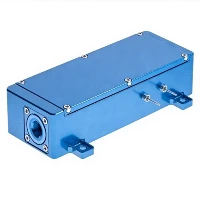

In the family of laser technology, fiber lasers, CO2 lasers and Nd:YAG lasers are the three most common laser light sources, each with its own unique characteristics and advantages.

Fiber lasers are favored for their high efficiency, small size and low maintenance requirements; CO2 lasers have a place in industrial applications for their high power output and excellent cutting ability; and Nd:YAG lasers are popular for their excellent penetration ability and stability in extreme environments.
Basic principles and characteristics:
1. Working principle and characteristics of fiber lasers
Working principle: Fiber lasers use glass optical fibers doped with rare earth elements as gain media, and achieve "particle number inversion" of laser working materials by forming high power density in the optical fiber, and form laser oscillation output in the positive feedback loop (constituting the resonant cavity).
Features: Fiber lasers have the characteristics of small size, high efficiency, good beam quality, low maintenance cost and long life. They are widely used in communications, medical treatment, material processing and other fields, and can operate stably in extreme environments.
2. Working principle and characteristics of CO2 laser
Working principle: CO2 laser is a gas laser whose working medium is carbon dioxide. It generates laser light by exciting CO2 molecules through discharge, and the wavelength is usually 10.6 microns. The working mode can be continuous or pulsed.
Features: CO2 laser can provide high-power continuous wave output, which is suitable for the processing of metal and non-metal materials. Its main advantages are high power and high energy output, but its disadvantages are high requirements for cooling system and relatively high maintenance cost.
3. Working principle and characteristics of Nd:YAG laser
Working principle: Nd:YAG laser uses neodymium-doped yttrium aluminum garnet (YAG) crystal as gain medium. The neodymium ions are excited by pump sources (such as flash lamps or laser diodes) to produce stimulated radiation, thereby generating laser light.
Features: The main characteristics of Nd:YAG laser are its excellent penetration ability and high energy output. It can work stably in various environments, especially suitable for heavy industrial applications such as cutting and welding. However, compared with fiber lasers, Nd:YAG lasers are slightly inferior in terms of maintainability and electro-optical conversion efficiency.
Comparison of core features:
1. Comparison of wavelength and beam quality
Fiber laser: Fiber lasers usually have a wavelength of 1060-1090 nm, which is suitable for metal processing, with excellent beam quality and suitable for precision processing.
CO2 laser: CO2 lasers have a wavelength of 10.6 μm and are mainly used for non-metallic material processing, such as wood, plastic, etc., and their beam quality performs well in high-power applications.
Nd:YAG laser: Nd:YAG lasers have a wavelength of 1064 nm and are suitable for processing a variety of materials, especially metals, and their beam quality performs well in medium-power applications.
2. Comparison of output power and efficiency
Fiber laser: Fiber lasers have high photoelectric conversion efficiency (up to 30%) and can provide high-power output.
CO2 lasers: CO2 lasers have relatively low photoelectric conversion efficiency, but due to their high power output, they are widely used in industrial processing that requires high power.
Nd:YAG laser: Nd:YAG lasers have moderate efficiency and are typically used in applications that require high precision and high energy density.
3. Comparison of heat management and cooling requirements
Fiber lasers: Fiber lasers typically use air-cooling systems, have simple structures, and require low cooling.
CO2 lasers: CO2 lasers require complex water-cooling systems because they generate a lot of heat during operation.
Nd:YAG lasers: Nd:YAG lasers require higher cooling than fiber lasers, but lower than CO2 lasers, so their maintenance is slightly more complicated.
4. Comparison of system maintenance and service life
Fiber lasers: Fiber lasers have low maintenance costs, a service life of more than 10,000 hours, and high stability.
CO2 lasers: CO2 lasers require regular maintenance, have a shorter life, and have a higher cost of use.
Nd:YAG lasers: Nd:YAG lasers have a maintenance and service life that is between fiber lasers and CO2 lasers, and require proper maintenance to maintain performance.
The three lasers have their own strengths. Fiber lasers excel in high efficiency, low maintenance, and long life; CO2 lasers have unique advantages in processing non-metallic materials; Nd:YAG lasers have some advantages of both, especially in the field of metal processing. Choosing the right type of laser according to specific application requirements is the key.
In industrial manufacturing and processing, medical applications, scientific research and military, and special environments, fiber lasers, CO2 lasers, and Nd:YAG lasers each have their own unique applicability and advantages.
1. Industrial manufacturing and processing applications
Fiber lasers: Due to their high efficiency, small size, and low maintenance requirements, fiber lasers are very suitable for precision processing, such as microelectronics manufacturing, metal cutting, and welding.
CO2 lasers: CO2 lasers excel in processing non-metallic materials such as plastics, wood, and textiles, and are often used in packaging, advertising, and manufacturing.
Nd:YAG lasers: Nd:YAG lasers are suitable for heavy industrial applications, such as large-scale machining and shipbuilding, and can provide high power and high energy output, suitable for cutting thick metal plates.
2. Comparison of advantages in medical applications
Fiber lasers: In the medical field, especially in minimally invasive surgery and diagnostic equipment, fiber lasers are favored for their flexibility and precision.
CO2 lasers: CO2 lasers are commonly used in skin treatment and plastic surgery, and can provide high-precision treatment effects.
Nd:YAG lasers: Nd:YAG lasers are widely used in ophthalmic surgery and can be used to treat diseases such as glaucoma. They are also used in dentistry and tumor resection.
3. Compatibility of scientific research and military applications
Fiber lasers: In scientific research, fiber lasers are widely used for their tunability and high beam quality, and are suitable for optical experiments and testing.
CO2 lasers: CO2 lasers are suitable for remote sensing and chemical analysis, especially in environmental monitoring and atmospheric research.
Nd:YAG lasers: In military applications, Nd:YAG lasers are often used for target marking, ranging, and laser-guided weapon systems.
4. Performance in special environments
Fiber lasers: Fiber lasers perform well in extreme environments, including high temperature, high vibration, and electromagnetic interference environments, making them ideal for aerospace and ocean exploration.
CO2 lasers: CO2 lasers excel in environments that require high power output and wide range of operation, such as large manufacturing plants.
Nd:YAG lasers: Nd:YAG lasers are stable and reliable in outdoor and mobile environments, suitable for battlefield and field operation environments.
In general, when choosing a laser, the most appropriate type should be determined based on the needs and environmental conditions of the specific application. Each laser has its own unique advantages and limitations, and the right choice can maximize its performance and efficiency.
Fiber lasers, CO2 lasers, and Nd:YAG lasers each have their own unique advantages and disadvantages. Fiber lasers are known for their high efficiency, excellent beam quality, and low maintenance requirements, but they are expensive; CO2 lasers perform well in processing non-metallic materials, especially for large-scale industrial processing, but their cooling systems are complex and relatively inefficient; Nd:YAG lasers perform well in metal processing and high-power applications, but their maintenance requirements and complexity are relatively high.
For different types of application requirements, the following recommendations are made: For precision processing and medical applications, fiber lasers are preferred; for non-metal processing and large-format material processing, CO2 lasers are ideal; and for heavy industry and high-power applications, Nd:YAG lasers are the best choice.
Contact information:
If you have any ideas, feel free to talk to us. No matter where our customers are and what our requirements are, we will follow our goal to provide our customers with high quality, low prices, and the best service.
 Email:info@loshield.com
 Tel:0086-18092277517
 Fax: 86-29-81323155
 Wechat:0086-18092277517


