



The short answer is: No-closing your eyes does NOT provide reliable or adequate protection against laser radiation, especially from moderate- to high-power lasers (Class 3B and Class 4). In fact, relying on closed eyelids as a safety measure can create a dangerous false sense of security and may lead to severe, permanent eye injury.
Below is a detailed, scientifically grounded explanation that covers the optical, biological, and regulatory aspects of this question-structured for clarity and completeness.
1. The Anatomy and Optical Properties of the Eyelid
Transmittance of Human Eyelids to Light
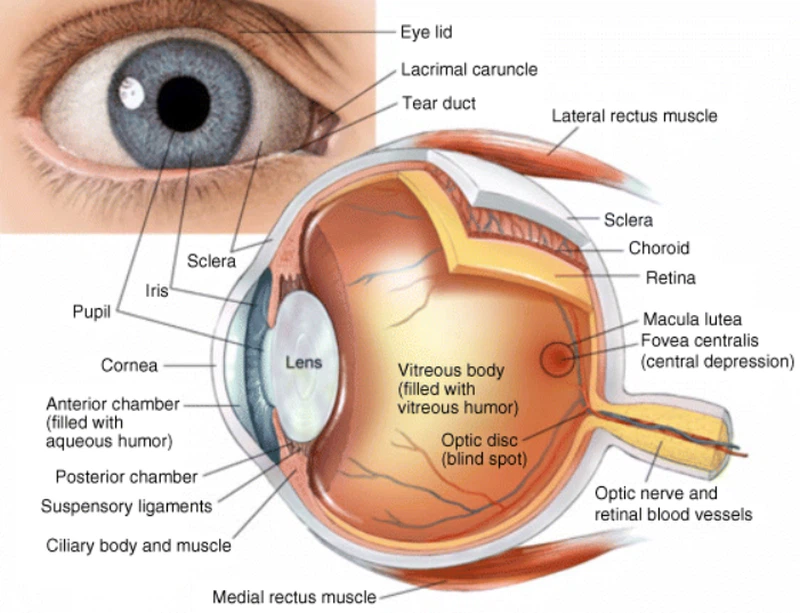
The human eyelid is composed of skin, muscle, blood vessels, and connective tissue-but it is not opaque to all wavelengths of light. Its ability to block light depends heavily on the wavelength of the incident radiation:
表格
| Wavelength Range | Approximate Eyelid Transmittance | Notes |
|---|---|---|
| Visible light (400–700 nm) | 10% to 25% | Red light (650 nm) transmits more than blue (450 nm). Studies show ~15–20% of green (532 nm) laser light penetrates closed eyelids. |
| Near-infrared (700–1400 nm) | Up to 50% or more | This range includes common high-power lasers like Nd:YAG (1064 nm). Eyelids are highly transparent to NIR-making them especially dangerous. |
| Ultraviolet (UV, <400 nm) | <1% | Mostly absorbed by the cornea and eyelid skin; less retinal risk but high surface damage risk. |
| Far-infrared (>1400 nm) | Very low | Absorbed at the surface (cornea/skin); eyelids offer some protection, but thermal burns can still occur. |
🔬 Key Study: A classic experiment by Zuclich et al. (1980) demonstrated that ~20% of 514 nm (green) argon laser light penetrated closed human eyelids in vivo. For 1064 nm (NIR), transmittance can exceed 40–50%, depending on pigmentation and thickness.
Variability Among Individuals
People with lighter skin or thinner eyelids transmit more light.
Children's eyelids are generally thinner and more translucent.
Eye closure is rarely complete-a small gap often remains at the corners or center.
2. Why Even Small Transmission Can Cause Injury
Laser damage is non-linear and threshold-dependent. The retina is exquisitely sensitive:
The Maximum Permissible Exposure (MPE) for visible/NIR lasers can be as low as microwatts per cm² for momentary exposure.
A Class 3B laser (e.g., 100 mW at 532 nm) delivers 100,000 µW-far exceeding MPE.
If 20% of that (20 mW) reaches the retina through closed eyelids, it is still 1,000–10,000× above safe levels.
💥 Result: Even brief exposure to a reflected or direct beam from a Class 3B/4 laser with eyes closed can cause:
Retinal burns
Photocoagulation (protein denaturation)
Permanent scotomas (blind spots)
Macular damage (central vision loss)
Because the retina has no pain receptors, you may not realize injury has occurred until minutes or hours later.

3. Special Danger of Invisible Lasers (Infrared & UV)
Infrared Lasers (e.g., 1064 nm Nd:YAG, 1550 nm fiber lasers)
Invisible to the human eye → no blink reflex.
High eyelid transmittance → significant energy reaches the retina.
Delayed symptom onset → damage may be extensive before noticed.
🚫 Myth: "If I don't see the beam, it's safe."
Reality: Invisible beams are more dangerous because there's no natural aversion response.
Ultraviolet Lasers (e.g., 355 nm, 266 nm)
Mostly absorbed by the cornea and lens, not the retina.
Closed eyelids do block most UV, but:
High-power UV can still cause photokeratitis ("welder's flash") through partial transmission.
Chronic exposure contributes to cataracts.

4. What About the Blink Reflex (Aversion Response)?
The human blink reflex (aversion response) is a key safety mechanism for visible light:
Triggered within 0.25 seconds of bright light exposure.
Only effective for Class 2 lasers (<1 mW).
Does not apply to:
Invisible wavelengths (IR/UV),
Pulsed lasers (nanosecond pulses are faster than neural response),
Deliberate staring or alignment tasks.
❗ Critical point: Closing eyes after seeing a bright flash does not prevent injury from the initial pulse-especially with Q-switched or mode-locked lasers that deliver energy in billionths of a second.
5. Regulatory and Standards Perspective
All major laser safety standards explicitly reject eyelid closure as a protective measure:
ANSI Z136.1 (U.S.)
"The eyelids provide inadequate attenuation of laser radiation, particularly in the near-infrared region… Protective eyewear shall be used whenever engineering controls do not reduce exposure below the MPE."
- ANSI Z136.1-2022, Section 8.4
IEC 60825-1 (International)
"Exposure limits are based on unprotected eyes. The transmittance of the eyelid is not considered in MPE calculations for retinal hazards."
EN 207 (Europe – Laser Eye Protection Standard)
Requires eyewear to withstand direct laser exposure without melting or transmitting hazardous levels-precisely because natural barriers (like eyelids) are insufficient.

6. Real-World Accident Data
Numerous documented laser injuries have occurred even when victims had their eyes closed:
Case 1: A technician aligning a 500 mW 1064 nm laser looked away and closed his eyes upon seeing a reflection-but still suffered a permanent central scotoma due to NIR transmission.
Case 2: A student exposed to a pulsed Nd:YAG laser during a lab demo reported closing eyes instantly-but the 5 ns pulse delivered retinal damage before neural signals could trigger full closure.
These cases underscore that human reaction is too slow and biological barriers too weak against modern laser sources.
7. When Might Closed Eyelids Offer Some Reduction?
In very limited scenarios:
Low-power visible lasers (<1 mW, Class 2): Eyelids + blink reflex together reduce risk to negligible levels.
Diffuse reflections from low-energy beams: May lower dose slightly, but not eliminate it.
UV exposure: Offers modest protection against surface damage.
However, this is not "protection" in the safety-engineering sense-it's merely a minor attenuation that cannot be relied upon in any controlled or professional setting.
8. What Actually Protects Your Eyes?
Only certified laser safety eyewear provides reliable protection. Effective eyewear must:
Be rated for the exact wavelength(s) of the laser in use.
Provide sufficient Optical Density (OD) to reduce transmitted energy below the MPE.
Meet recognized standards (ANSI Z136.1, EN 207, etc.).
Be undamaged, clean, and properly fitted.
✅ Example: For a 200 mW (0.2 W) 532 nm laser, OD 4+ eyewear reduces exposure to 0.02 mW-well below MPE. Closed eyelids would still allow ~40 mW to reach the retina-2,000× too high.

9. Summary: Key Takeaways
| Question | Answer |
|---|---|
| Do closed eyelids block laser light? | Partially-but 10–50% of visible/NIR light still penetrates. |
| Is this enough to prevent injury? | No-transmitted energy often remains far above injury thresholds. |
| Are invisible lasers more dangerous? | Yes-no blink reflex + high eyelid transmittance = high risk. |
| Can I rely on closing my eyes during alignment? | Absolutely not-use proper eyewear and beam blocks. |
| What do safety standards say? | Eyelids are not considered protective; certified eyewear is mandatory for Class 3B/4. |
Final Verdict
Closing your eyes is not a safety measure-it is a biological limitation. In laser safety, we design controls that do not depend on human behavior or anatomy. Relying on eyelid closure violates the core principle of engineering out risk rather than hoping biology will save you.
🔒 Golden Rule of Laser Safety:
If the laser is Class 3B or Class 4, you must wear wavelength-specific, OD-rated laser safety eyewear-regardless of whether your eyes are open, closed, or looking away.
Your vision is irreplaceable. Never gamble with physics.