



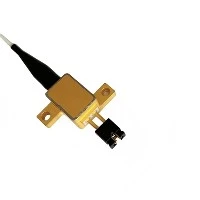
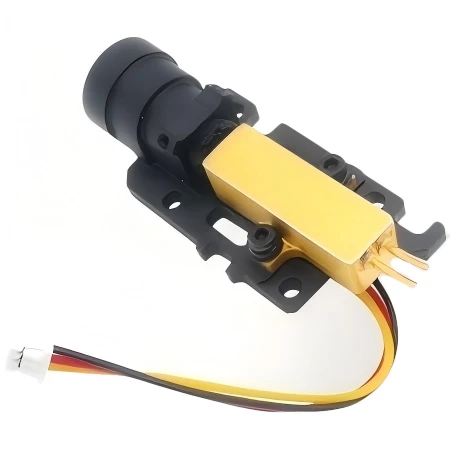
Microchip lasers, characterized by their compact monolithic architecture, high beam quality, and exceptional stability, are emerging as a pivotal enabling technology for Light Detection and Ranging (LiDAR). As LiDAR systems become increasingly critical for applications like autonomous driving and remote sensing, the demand for laser sources that are simultaneously high-performing, robust, and cost-effective intensifies.
1. Introduction
1.1 An Overview of LiDAR Technology
Light Detection and Ranging (LiDAR) is a remote sensing method that measures distance by illuminating a target with laser light and analyzing the reflected signal. A typical LiDAR system comprises three core components: a laser transmitter, a sensitive receiver (usually an avalanche photodiode), and a scanning mechanism (mechanical, MEMS, or solid-state). By calculating the Time-of-Flight (ToF) of the laser pulse or phase shifts in a continuous wave, LiDAR generates precise, high-resolution three-dimensional point cloud maps of the environment. Its applications span autonomous vehicles, robotics, topographic mapping, and unmanned aerial vehicle (UAV) navigation, with a clear market trend pushing for higher resolution, longer range, smaller form factors, and lower cost.
1.2 The Demand for an Ideal LiDAR Source
The performance of a LiDAR system is fundamentally constrained by the properties of its laser source. The ideal source must satisfy a demanding set of requirements:
High Peak Power: Essential for long-range detection, overcoming atmospheric attenuation.
Narrow Pulse Width: Critical for high ranging accuracy and resolution (sub-cm capability).
Excellent Beam Quality (Near-Diffraction-Limited): Ensures a small, focused spot at long distances, which directly translates to high angular resolution and target discrimination.
High Repetition Rate: Enables fast scanning and dense point clouds, improving frame rate and object recognition.
Miniaturization and Ruggedness: Mandatory for integration into mobile platforms like cars and drones.
High Reliability and Long Lifetime: Must withstand harsh environmental conditions (temperature, vibration) for industrial and automotive applications.
Low Cost: A prerequisite for mass-market commercialization.
1.3 Scope and Article Structure
This article posits that the microchip laser is a leading candidate to meet these multifaceted demands. The following sections will provide a detailed examination of microchip laser technology, its application in various LiDAR systems, and its future trajectory.
2. Microchip Laser Technology: A Detailed Examination
2.1 What is a Microchip Laser?
A microchip laser is a compact, solid-state laser where the resonant cavity is formed by a thin slice (typically <1 mm thick) of gain medium, with the cavity mirrors directly coated onto the crystal facets. This monolithic, "chip-like" design eliminates the need for discrete mirrors and complex alignment, resulting in an extremely robust and simple structure.
2.2 Operational Principle and Key Characteristics
The laser is optically pumped by a laser diode (LD). The extremely short cavity length leads to a large longitudinal mode spacing, often forcing single-frequency operation. The primary operational mode for pulsed LiDAR is Q-switching:
Active Q-Switching: An electro-optic or acousto-optic modulator inside the cavity is used to generate precisely controlled, high-energy pulses.
Passive Q-Switching: A saturable absorber material (e.g., Cr:YAG) is integrated into the microchip structure. This allows for self-pulsing, making the laser simpler, more compact, and lower cost, though with less timing control.
This mechanism produces nanosecond-duration pulses with kilowatt to megawatt-level peak power-an ideal combination for direct ToF LiDAR.
2.3 The Core Advantages of Microchip Lasers
Compactness and Integrability: Their monolithic, all-solid-state design allows for packaging in a volume of a few cubic centimeters or less, facilitating integration into space-constrained systems.
Superior Beam Quality: The design inherently supports fundamental transverse mode (TEM00) operation, resulting in a diffraction-limited beam with low divergence, which is crucial for long-range, high-resolution imaging.
High Peak Power and Narrow Pulse Width: The short cavity enables rapid energy extraction, producing the short, intense pulses required for precise ToF measurement.
High Efficiency and Stability: With integrated Thermoelectric Coolers (TECs), they maintain stable operation over a wide temperature range, ensuring consistent performance and long operational lifetime (>10,000 hours).
Low Power Consumption: Their high electrical-to-optical efficiency is ideal for battery-operated mobile platforms.

3. Specific Applications in LiDAR Systems
3.1 Applications by Ranging Principle
Direct Time-of-Flight (dToF) LiDAR: Microchip lasers serve as the ideal pulsed source. Their high peak power enables long-range detection (>200 m for automotive), while their narrow pulse width ensures high precision. They are the preferred source for high-performance automotive long-range LiDAR and aerial topographic mapping systems.
Frequency-Modulated Continuous-Wave (FMCW) LiDAR: Single-frequency, continuous-wave microchip lasers can be used as the source for FMCW LiDAR. When linearly frequency-chirped, they allow for simultaneous, highly accurate measurement of both range and instantaneous velocity, a key advantage for automotive collision avoidance and industrial metrology.
3.2 Applications by Platform and Scenario
Automotive LiDAR:
Forward-Looking Long-Range LiDAR: Utilizes high-power microchip laser arrays to achieve the >150m range required for highway-speed autonomous driving.
Short-Range/Side-LiDAR: Employs medium-power microchip lasers for near-field perception and blind-spot monitoring, leveraging their small size for seamless vehicle integration.
Airborne and Spaceborne LiDAR: The stringent weight and power constraints of UAVs and satellites make the small size and high efficiency of microchip lasers the technology of choice for applications like forest canopy mapping and planetary exploration.
Industrial and Robotics LiDAR: Used in Automated Guided Vehicles (AGVs) for navigation and obstacle avoidance, and in 3D profiling systems for quality control. Their ruggedness ensures reliable operation in demanding factory environments.
Consumer Electronics: The ongoing miniaturization of microchip lasers makes them a leading candidate for integration into smartphones, AR/VR headsets, and smart home devices for applications like facial recognition, gesture control, and 3D object scanning.
4. Technical Challenges and Future Trends
4.1 Prevailing Technical Challenges
Cost: The precision manufacturing, crystal materials, and packaging currently make them more expensive than high-volume alternatives like Edge-Emitting Lasers (EELs). Cost reduction is key for mass adoption.
Power Scaling: The output power from a single emitter is limited. Scaling to higher power requires laser arraying or Master Oscillator Power Amplifier (MOPA) configurations, which add complexity.
Wavelength Diversification: While 1.06 μm is common, the eye-safe spectral regions (1.5 μm and 2 μm) are critical for many public-facing applications. Developing high-performance microchip lasers at these wavelengths remains an active R&D area.
System-on-Chip Integration: The full integration of the laser, scanner (e.g., MEMS), detector, and electronics onto a single photonic integrated circuit (PIC) presents significant fabrication and packaging challenges.
4.2 Future Development Trends
Chip-Scale Mass Production: Leveraging semiconductor fabrication techniques to produce microchip lasers on wafers, dramatically reducing cost and improving manufacturing yield and consistency.
Wavelength Expansion: Development of new gain materials to cover a broader spectrum, from visible to mid-infrared, tailored for specific applications like underwater LiDAR or atmospheric sensing.
Intelligent and Functional Integration: Embedding monitoring, diagnostics, and smart driver circuitry directly into the laser package for enhanced performance and reliability.
Novel Materials and Structures: Exploration of new gain media, such as thin-film lithium niobate (TFLN) for integrated modulators, and quantum dot materials, to push the boundaries of performance and functionality.
5. Conclusion and Outlook
In summary, microchip lasers offer a compelling blend of performance, size, and robustness that directly addresses the core needs of modern LiDAR systems. Their superior beam quality, high peak power in short pulses, and monolithic durability position them as a cornerstone technology for advancing LiDAR towards higher performance and broader commercialization.
Looking ahead, as manufacturing scales and costs decline, microchip lasers are expected to transition from specialized, high-end systems to ubiquitous components in mass-market products. They are set to become the "bright eyes" of future intelligent perception systems, providing the critical sensing capability that will underpin the autonomous, interconnected, and digitally-mapped world of tomorrow.
Contact information:
If you have any ideas, feel free to talk to us. No matter where our customers are and what our requirements are, we will follow our goal to provide our customers with high quality, low prices, and the best service.
 Email:info@loshield.com
 Tel:0086-18092277517
 Fax:86-29-81323155
 Wechat:0086-18092277517


