



A Laser is a device that transfers energy from an active medium to an output beam. The working mode of the laser has an important impact on the performance and application of the laser. In the operation of lasers, QCW (pulse modulation width), CW (continuous wave) and PW (pulse wave) are common working modes. There are clear differences between these working modes, which will be analyzed in detail below.
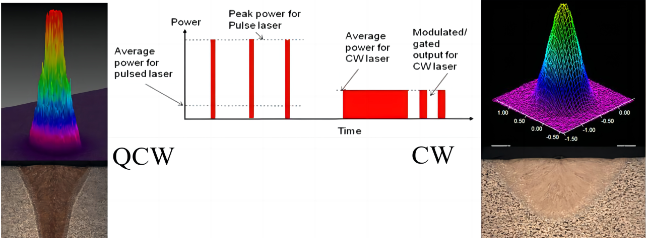
QCW (pulse modulation width) operating mode means that the laser operates in the form of pulses, and the duration (width) of each pulse is limited. QCW lasers typically emit pulses repeatedly at a high frequency, with certain intervals between pulses. The width of the pulse can be modulated as needed to control the laser output power and pulse energy. This working mode is suitable for application scenarios that require high time resolution, such as radar systems, medical equipment, etc. In these applications, the QCW laser's high-energy short pulses can provide precise measurements and therapeutic effects.
CW (continuous wave) operating mode means that the laser works in a continuous manner, and the energy of the output beam remains constant and uninterrupted. The output power of CW lasers is relatively low but can remain stable. CW working mode is suitable for applications that require continuous output of laser energy, such as fiber optic communications, material processing, etc. In these applications, CW lasers provide stable laser energy for continuous needs in signal transmission or material processing.
PW (pulse wave) operating mode means that the laser operates in the form of a single pulse. Each pulse has high energy and short duration. PW lasers are typically used in applications that require high-energy short pulses, such as laser cutting, laser drilling, etc. In these applications, the high-energy pulses of PW lasers can complete material processing tasks quickly and accurately.
In addition to the differences in working modes, QCW, CW and PW lasers also have obvious differences in other aspects.
First, the QCW laser has a high pulse repetition frequency and a short interval between pulses, so it can generate a large number of pulses in a short period of time. CW lasers operate in a continuous manner with no intervals between pulses. In the PW laser operating mode, the interval between pulses is also relatively long.

Secondly, the output power and pulse energy of the laser are also different in the three working modes. Because the QCW laser emits pulses at a high frequency, it can output a large pulse energy per unit time. CW lasers operate as continuous waves, so their output power is relatively low. The energy of each pulse of the PW laser is larger under the pulse waveform, but the interval between pulses is longer, so the energy output per unit time is relatively low.
Thirdly, the three working modes also have different application needs and performance requirements. QCW lasers are suitable for applications that require high temporal resolution and can provide high-energy short pulses. CW lasers are suitable for applications that require continuous output of laser energy and have stable output power. PW lasers are suitable for applications requiring short pulses of high energy to complete material processing tasks quickly and accurately.
To sum up, there are obvious differences between the QCW, CW and PW working modes of lasers in terms of working mode, output power and pulse energy. Selecting the operating mode for a specific application can best meet your needs and improve laser performance.
Contact information:
If you have any ideas, feel free to talk to us. No matter where our customers are and what our requirements are, we will follow our goal to provide our customers with high quality, low prices, and the best service.
 Email:info@loshield.com
 Tel:0086-18092277517
 Fax: 86-29-81323155
 Wechat:0086-18092277517


