


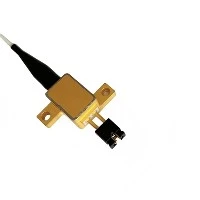
DOE Module play an important role in providing process-appropriate laser beam shaping. This makes laser beam shaping and homogenization techniques essential for many optimized laser material processing applications. Usually the laser system starts from the use of laser, and the performance is improved by adding DOE. The key parameters to realize are: Processing speed and output doubled; Process accuracy: wall steepness, heat affected zone, treatment effectiveness.
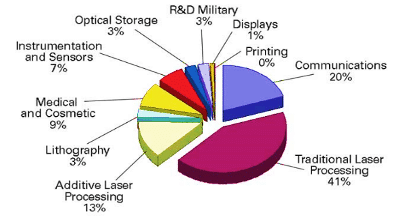
Recently, demands for the development of new laser systems for industrial use have increased. And many new processes have been produced, and the laser additive system has replaced many traditional industrial processes. As shown in the figure below, material processing holds a large share of the overall laser market:
DOE Module Applications--Ablation and Structuring
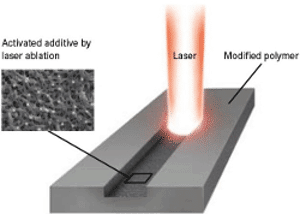
Laser ablation is the process of removing material from solid (or occasionally liquid) surfaces by shining a laser beam. Laser ablation is accomplished by applying short pulses of high energy over a small area. Laser ablation has been considered and is actually used in many technological applications, including: the generation of nanomaterials, the deposition of metal and dielectric thin films, the fabrication of superconducting materials, the routine welding and bonding of metal parts, and the micromachining of MEMS structures. Our top-hat beams and vortex lenses produce well-shaped, sharp-edged spots for precise material removal during ablation. The multipoint feature enables parallel processing, which increases throughput.

DOE Module Applications--Welding
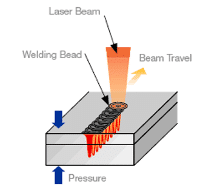
Laser welding technology is used to join multiple pieces of metal or plastic with a laser. The beam provides a concentrated heat source that allows for narrow, deep welds and high welding rates. This process is often used in high-volume applications such as automation, such as in the automotive industry. Combined with cutting technology, lasers are ideal for many types of welding (spot welding, wire welding, soldering).
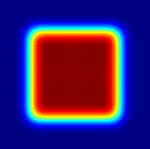
Our homogenizer elements have a uniform, flat intensity profile, independent of inhomogeneities in the input, and can be engineered into a shape distribution tailored to a specific welding profile. Using the trail multipoint profile, it is possible to preheat the weld area and then post-process it.
|
|
|
| Laser Welding | Homogenizer Energy Distribution |
DOE Module Applications--Brazing
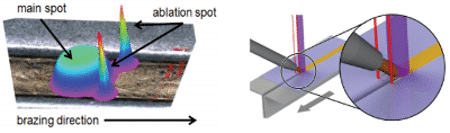
In laser brazing applications, two metal plates are joined by a laser-melted solder wire. It has been proven that the quality of the connection improves when the metal surface is cleaned and preheated before the brazing wire melts. Typical applications are in the automotive industry. For this purpose we offer a special homogenizer element which produces two small leading beams for cleaning/preheating and one large homogenizing beam which distributes the energy evenly over the brazing wire for better Melting and cleaner edges.
 |
|
| Laser Ablation Process | Customized Homogenizer Energy Distribution |
DOE Module Applications--Perforation
Perforations are small holes in thin materials or webs. Laser perforation is commonly used in the food industry for thin sheet materials such as cigarette butt paper or packaging foil (prolonging the freshness and quality of perishable foods). Such applications require precise microscopic holes with a pre-designed pattern of equal distances. Beam splitters DOEs provide the obvious solution.
 |
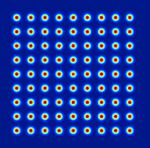 |
| Laser Drilling of Food Packaging | 9×9 Multipoint Beam DOE Laser Module |
DOE Module Applications--Laser Cutting (Metal and Glass)
Laser cutting works by directing the output of a high power laser, usually through an optical system & moving stage, scanning the focal point on the workpiece and cutting. It is commonly used in industrial manufacturing applications. Its purpose is to expand the depth of focus of the system without increasing the focal length of the focusing optical system, or to improve cutting quality, reduce spalling and material re-melting in the cutting area.
Laser cutting of metals locally heats the material above its melting point at the focal point of a focused laser beam. The resulting molten material is ejected by the air stream, forming an open cut.
Glass laser cutting, or laser cutting, is usually performed with high-power lasers in the infrared range. Because glass absorbs light less at most wavelengths, more powerful laser-cut glass is required. By using a focused DOE, the energy is spread across a large portion of the glass wafer. This allows a single-pass cut without having to adjust the depth of focus and z-shift of the spot during the cut. This is especially useful for stealth cutting, where a laser alters the glass to make it brittle, as opposed to ablative cutting, where the glass is then mechanically separated along the laser processing line.
DOE Module Applications--Drilling
Laser drilling is the process of forming through holes by repeatedly focusing pulsed laser energy on a material and evaporating the molten material. The greater the pulse energy, the more material is melted and evaporated. Over the years, several laser drilling techniques have been developed, including signal pulse, percussion, trepanation and helical drilling. Laser drilling is used in many applications, including the drilling of silicon wafers and rubber.
For increased productivity and productivity, our Multi-Spot beamsplitters have been proven to deliver accurate results. Flat-hat beam shapers improve hole edge quality and diameter accuracy, while vortex phase plates enable annular shapes to be drilled.
DOE Module Applications--Laser Stripping
Laser lift-off (LLO) is a technique for the selective removal of one material from another. The laser beam is projected through the transparent material and absorbed by the adjacent material on the backside, such as GaN on sapphire. The laser lift-off separation process can handle large area devices with the required finesse and repeatability. Therefore, in the LED industry, split light-emitting films are very common in displays for televisions and mobile devices.
The M2 conversion module is part of our full fine lineshaping solution for converting multimode circular input beams into narrow laser lines, especially in the UV and green wavelengths (343, 355 and 532 nm). Our solutions are based on a proprietary diffractive beam shaping concept and can be customized for any wavelength from 193nm deep ultraviolet to 1600nm infrared lasers. By utilizing our solution, efficient power densities can be achieved in thin lines using lower cost multi-mode lasers.
DOE Module Applications--Surface Treatment (hardening and remelting)
The principle of laser surface treatment is the interaction between a coherent beam of high power density and a surface in a defined gas (vacuum, protective gas or process gas) resulting in surface modification. Some typical uses of laser surface treatment are laser hardening and laser remelting. Laser hardening is a thermal surface hardening process in which the material is heated above a critical temperature for a short period of time and then cooled rapidly, preventing the metal lattice from returning to its original structure and producing a very hard metal structure. Laser remelting is another thermal method of surface preparation. Briefly heat the surface of the component above the melting temperature. The melt then solidifies and recrystallizes without fundamental changes in chemical composition.
Related Products
1. Diffraction Beam Splitter
Diffractive beam splitter (lattice beam splitter) is one of the most basic diffractive optical elements. Its function is to divide a single incident light into several beams or multiple beams, and each beam has the characteristics of the original beam (except its power and propagation angle changes without changing the initial beam diameter, divergence angle and wavefront distribution). The output of the beam splitter can be arranged in one-dimensional or two-dimensional, and can also realize a line spot array. The arrangement can be completely customized by the user, which is realized by designing the diffraction pattern on the surface of the beam splitter. At the same time, the number of output beams, the angle between beams, the length and number of straight lines can be customized arbitrarily. The number of beams is not limited, it can be 2 beams, 3 beams, or hundreds or even tens of thousands of beams. We provide a large number of standard diffractive beam splitters for customers to choose from, including one-dimensional beam array (1×N) or two-dimensional beam matrix (M×N). There are about 100 standard models for only one wavelength of 1064nm. The specifications of the one-dimensional laser beam splitter include but are not limited to one-two, one-four, one-six, and one-hundred, and the specifications of the two-dimensional beam splitter. Including 2×2, 3×3, 7×7, 100×100, 128×64, etc., up to a million bundles.

Depending on the diffraction pattern on the element, a diffractive beam splitter can generate a 1D beam array (1xN) or a 2D beam matrix (MxN). Diffractive beam splitters are used with monochromatic light, such as laser beams, and can be designed for specific wavelengths and specific output beam splitting angles. Typical applications for beam splitters include: laser scribing e.g. in solar cells or panels, laser scribing, laser drilling, medical/cosmetic applications (e.g. skin care), 3D sensing and projection.
Beam homogenizer (diffuser)
Beam homogenizer (diffuser) products convert any collimated input beam into an output beam with uniform intensity. Works with any wavelength and with any shape. Beam homogenizers are useful in many applications that require a clearly defined beam shape with a randomly distributed intensity profile. The output of a beam homogenizer is largely dependent on the input beam: multimode laser beams are actually advantageous in the use of beam homogenizers over single-mode lasers because their lower coherence reduces the visibility of the speckle , so that the output light with more uniform intensity can be obtained.
Typical applications for beam homogenizers (diffusers) include: laser beam spot shaping; laser material processing such as: ablation, derailing, marking, scribing and welding; medical/cosmetic laser treatments; beam shaping and hot spots for excimer lasers reduce.

Contact information:
If you have any ideas, feel free to talk to us. No matter where our customers are and what our requirements are, we will follow our goal to provide our customers with high quality, low prices, and the best service.
 Email:info@loshield.com
 Tel:0086-18092277517
 Fax: 86-29-81323155
 Wechat:0086-18092277517


