



The safety landscape for handheld laser processing has just taken an important step forward.
ISO 11553-2:2026, Safety of machinery - Laser processing machines - Part 2: Safety requirements for hand-held or hand-operated laser processing machines, was officially published in August 2026. The new edition addresses significant hazards associated with hand-held and hand-operated laser processing machines and sets out requirements related to hazard analysis, risk assessment and protective measures.
For companies using handheld laser welding, laser cleaning and other manually guided laser processing systems, the publication is a timely reminder of an important principle:
Laser safety should be designed around the entire working environment - not around the laser source alone.
That makes protective measures such as a properly selected laser safety screen, laser safety barrier or laser enclosure an increasingly important part of industrial laser safety planning.
Why ISO 11553-2:2026 Matters to Handheld Laser Users
Unlike a conventional enclosed laser processing machine, a handheld laser system introduces a unique working situation.
The operator physically guides either the laser processing head or the workpiece. The location and direction of the laser beam can therefore vary during operation. Depending on the application, reflections, incorrect positioning, unintended laser radiation and access by other personnel may all need to be considered during the risk assessment.
ISO 11553-2:2026 specifically addresses hand-held and hand-operated laser processing machines and includes requirements relating to laser radiation hazards, control systems, thermal hazards, electrical hazards, materials and substances, ergonomics, and hazards affecting unauthorized persons or third parties.
For a handheld laser welding workstation, this means safety planning should consider not only the person holding the welding gun, but also technicians, supervisors and other employees who may be working nearby.
This is where physical separation of the laser processing area becomes especially relevant.
Why a Laser Safety Screen Is More Than a Simple Workshop Partition
A standard welding curtain and a laser safety screen are not the same thing.
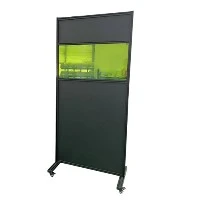
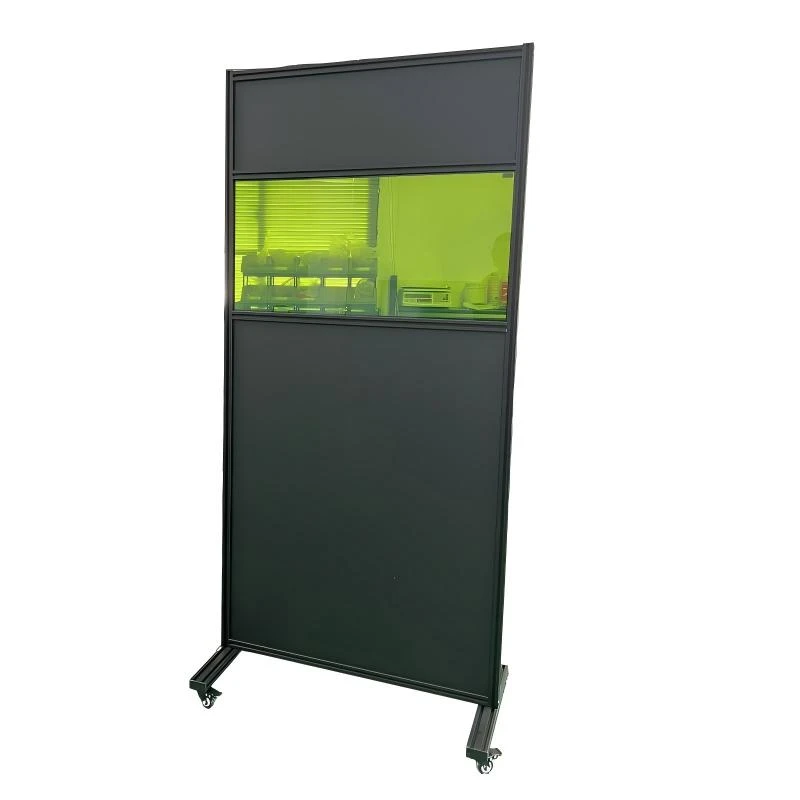
A laser safety screen is intended to reduce hazardous laser radiation outside a defined laser working area. Depending on its design, it may form part of a temporary workstation, a mobile welding area, a fixed laser barrier system or a more complete laser enclosure.
IEC 60825-4:2022 specifically addresses laser guards and provides guidance on protective housings and enclosures for high-power lasers. Its scope includes visibly transmitting screens, viewing windows, panels, laser curtains and walls, as well as methods for assessing, specifying and selecting their protective properties.
This distinction is important.
A laser safety screen should not be selected simply because it is dark, opaque, flame-resistant or marketed as a general welding curtain. The protective properties of the barrier need to be appropriate for the actual laser application.
Handheld Laser Welding Changes the Safety Scenario
Handheld laser welding has become increasingly attractive in industrial manufacturing because of its flexibility and ability to process a wide variety of components.
That flexibility, however, also means that the beam is not necessarily confined within a traditional fixed processing cabinet.
During normal work, the angle between the laser head, workpiece and surrounding surfaces may change. Metallic surfaces can also create reflected radiation that needs to be considered as part of the application-specific risk assessment.
For this reason, creating a controlled laser working area can be particularly important in facilities where handheld laser welding is performed close to other production activities.
A properly designed laser welding safety screen system can help separate the laser processing zone from surrounding personnel while maintaining the flexibility needed for loading large or irregular workpieces.
But the screen is only one part of the overall safety concept. Training, access control, machine safety functions, appropriate personal protective equipment, operating procedures and other engineering controls may also be required depending on the risk assessment and applicable regulations.
Laser Safety Screen or Full Laser Enclosure?
One of the most common questions when planning a handheld laser workstation is whether a laser safety screen is sufficient or whether a fully enclosed laser safety cabin is required.
There is no universal answer.
The appropriate solution depends on the laser, the application, the workstation layout and the results of the risk assessment.
A modular laser safety screen can be useful where flexibility is important. Mobile or modular panels can create a designated working zone and can often be reconfigured when production requirements change.
A full laser enclosure, on the other hand, provides more complete physical separation of the process area and can incorporate features such as interlocked doors, warning systems and laser-safe viewing windows.
IEC 60825-4:2022 addresses both permanent and temporary laser guards and includes considerations such as human access, interlocking, labelling and the design of protective housings and enclosures.
The correct choice therefore should be based on engineering evaluation rather than simply selecting the largest or thickest barrier available.
What Should You Check When Selecting a Laser Safety Screen?
For purchasing teams, laser safety officers, EHS managers and system integrators, specifying the screen correctly is more important than choosing it by appearance alone.
Before selecting a laser safety screen, the following information should normally be identified:
Laser wavelength – The protective properties of a laser barrier depend on the wavelength or wavelength range involved.
Maximum laser power or energy – The barrier needs to be evaluated for the actual laser source and foreseeable exposure conditions.
Continuous-wave or pulsed operation – Different emission characteristics can create different protective requirements.
Application – Welding, cleaning, cutting and other laser processes can create different working conditions.
Distance between the laser process and the screen – Irradiance at the protective barrier can depend significantly on geometry and distance.
Possible direct or reflected exposure – Workpiece material, surface condition and beam orientation should be considered.
Required screen dimensions and layout – Height, width, gaps, joints and access points can all affect the effectiveness of the controlled area.
Fixed or mobile installation – Some production environments require permanent protection, while others benefit from modular or movable laser safety barriers.
Viewing requirements – Where operators need to observe the process, an appropriately specified laser safety viewing window may be required.
Applicable standards and local regulations – Requirements can vary according to market, application and workplace regulations.
These details allow a laser safety screen to be evaluated as part of a complete protection concept rather than as an isolated accessory.
ISO 11553-2:2026 and IEC 60825-4:2022: Different Roles, Same Safety Objective
It is useful to understand the difference between these two standards.
ISO 11553-2:2026 focuses on the safety of hand-held or hand-operated laser processing machines. It identifies relevant hazards and addresses risk assessment and protective measures for this category of industrial equipment. The 2026 edition is the second edition and replaces ISO 11553-2:2007. According to ISO, the new edition applies to relevant HLMs manufactured from the date of publication rather than machines manufactured before the standard was published.
IEC 60825-4:2022, meanwhile, focuses specifically on laser guards. It covers permanent and temporary guards around laser processing zones and includes screens, windows, panels, curtains and walls. It also explains how the protective properties of laser guards can be assessed and specified. ()
In other words, ISO 11553-2:2026 helps frame the broader machinery safety and risk-reduction requirements, while IEC 60825-4 provides important technical guidance when laser guards form part of that protective strategy.
A laser safety screen alone does not automatically make a handheld laser workstation compliant with either standard. The complete installation, operating conditions and applicable regulations must be evaluated.
From "Wear Laser Safety Glasses" to "Design a Safe Laser Working Area"
One of the most important changes in how industrial users approach laser safety is the growing focus on engineering controls.
Laser protective eyewear remains important where required, but personal protective equipment should not be viewed as the only protection between hazardous laser radiation and personnel.
For example, OSHA guidance in the United States gives primary consideration to engineering controls when limiting access to laser radiation and discusses protective housings, enclosures and protection from reflected infrared laser radiation.
For modern handheld laser welding operations, this supports a broader approach:
Control the hazard at the workstation, restrict access to the laser processing area, and then use appropriate PPE and procedures as additional layers of protection.
A well-designed laser safety screen or enclosure can therefore play an important role in turning an open production area into a more clearly controlled laser working zone.
What This Means for Manufacturers and System Integrators in 2026
The publication of ISO 11553-2:2026 gives manufacturers, integrators and end users another reason to review how handheld laser equipment is installed and operated.
When a handheld laser welding machine is added to a factory, safety planning should begin before the machine reaches the production floor.
Questions such as where the operator will stand, where other employees can walk, what surfaces are located around the workstation, how material will enter and leave the area, and whether the screen needs to be moved between jobs can directly affect the protection strategy.
For system integrators, this also creates an opportunity to design laser safety as part of the workstation from the beginning rather than adding barriers after installation.
Modular laser safety panels, laser protective viewing windows, interlocked enclosures and customized laser safety cabins can all form part of that engineering process when appropriately specified.
Need Help Selecting a Laser Safety Screen?
Choosing the right laser safety barrier starts with understanding the laser and the application.
At JTBYShield, we provide laser protection solutions for industrial laser applications, including laser safety screens, laser safety barriers, laser protective windows and customized laser safety enclosures.
To help evaluate a suitable solution for your application, send us the following information:
laser wavelength, maximum power, laser operating mode, application, approximate distance from the laser process to the barrier, required screen dimensions and installation type.
Our team can then help you identify a laser protection solution based on your workstation requirements.
Contact JTBYShield to discuss your handheld laser welding safety project.
Disclaimer: This article is intended for general technical information only. Selection of laser safety equipment should be based on a documented risk assessment and the applicable standards, regulations and requirements for the specific installation. Always consult the relevant standards and a qualified laser safety professional where required.