



When working with or near X-ray equipment-whether in a hospital, dental clinic, veterinary practice, airport security checkpoint, or industrial testing facility-radiation exposure is an invisible but real risk. Unlike heat, noise, or chemicals, you can't see, hear, or feel ionizing radiation. That's why X-ray Personal Protective Equipment (PPE) is not optional-it's a critical line of defense for anyone regularly exposed to scattered radiation.
This guide explains what X-ray PPE is, how it works, the different types available, and best practices for use-all from a beginner-friendly perspective and aligned with international safety standards.
🔬 What Is X-Ray PPE?
X-ray PPE refers to wearable gear designed to absorb or block scattered X-ray radiation during diagnostic or therapeutic procedures. It does not protect against the primary X-ray beam (which is directed at the patient), but it significantly reduces exposure to secondary (scattered) radiation that bounces off the patient or equipment.
✅ Key Principle: X-ray PPE shields specific body parts-especially those most sensitive to radiation, like the thyroid, eyes, and reproductive organs.

🛡️ Common Types of X-Ray PPE
1. Lead Aprons
Purpose: Protect the torso (chest, abdomen, back).
Lead Equivalence: Typically 0.25 mmPb, 0.35 mmPb, or 0.5 mmPb.
0.25 mmPb: Blocks ~90% of scattered radiation (common in dentistry/veterinary).
0.5 mmPb: Blocks ~99% (standard in interventional radiology or cath labs).
Modern Options: Lightweight composites using lead-free materials (e.g., tin, antimony, barium) that offer similar protection with 20–30% less weight.
2. Thyroid Shields (Collars)
Purpose: Shield the thyroid gland in the neck-a highly radiosensitive organ.
Worn with: Lead aprons during fluoroscopy, CT guidance, or mobile X-rays.
Effectiveness: Can reduce thyroid dose by up to 90%.
3. Lead Glasses / Radiation Protection Eyewear
Purpose: Protect the lens of the eye from cataract-inducing radiation.
Lead Equivalence: Usually 0.35–0.75 mmPb in lenses.
Design: Wrap-around styles minimize side exposure; some include side shields.
4. Lead Gloves
Use Case: Only when hands must be near the primary beam (e.g., certain interventional procedures).
Caution: Not recommended if hands are in the direct X-ray field-can increase patient dose due to automatic exposure control compensation.
Typical Equivalence: 0.25–0.5 mmPb.
5. Mobile Barriers & Ceiling-Suspended Shields
While not "worn," these are part of PPE systems. They provide superior protection by blocking radiation at the source and reducing reliance on wearable gear.
⚖️ How Protection Works: The Science Simplified
X-ray PPE uses high-density materials (traditionally lead, now often non-lead alternatives) to absorb photons through:
Photoelectric effect: Low-energy X-rays are fully absorbed.
Compton scattering: Higher-energy rays are deflected and weakened.
The lead equivalence (mmPb) tells you how much protection the material provides compared to pure lead of the same thickness-even if no actual lead is used.

📏 Choosing the Right PPE: Key Considerations
| Factor | Guidance |
|---|---|
| Work Environment | Dental techs may need only 0.25 mmPb; interventional cardiologists require 0.5 mmPb + eyewear + thyroid shield. |
| Weight vs. Protection | Lighter doesn't always mean safer. Balance comfort with required lead equivalence. |
| Fit & Coverage | Gaps = exposure. Aprons should overlap front and back; sleeves must cover shoulders. |
| Durability | Inspect for cracks, tears, or creases every 6–12 months (use fluoroscopy or X-ray to test integrity). |
🚫 Never fold lead aprons-this causes micro-cracks that compromise shielding.

🧼 Care & Maintenance Tips
Storage: Hang on approved hangers-never fold or drape over chairs.
Cleaning: Wipe with mild soap and water; avoid harsh chemicals.
Inspection: Annual testing per ASTM F3094 or IEC 61331-3 standards is mandatory in most countries.
Retirement: Replace after 5 years or if damage is found-even if it "looks fine."
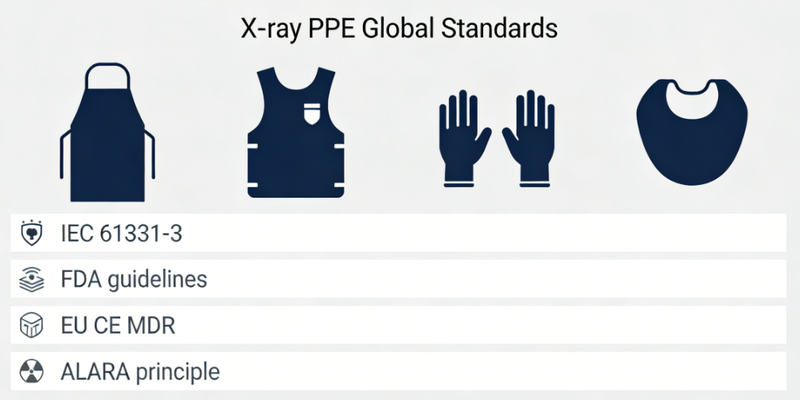
🌍 Global Standards & Regulations
X-ray PPE must comply with recognized safety frameworks:
International: IEC 61331-3 (performance & labeling)
USA: FDA guidelines + state radiation control programs
EU: CE marking under Medical Device Regulation (MDR)
Best Practice: ALARA principle (As Low As Reasonably Achievable)-minimize dose through PPE + distance + time.
❓ Frequently Asked Questions
Q: Do I need PPE if I'm just passing through an X-ray room?
A: No-but never enter during an active exposure. Staff who routinely work near X-ray sources must wear appropriate PPE.
Q: Are lead-free aprons as effective?
A: Yes-if they meet the same lead equivalence standard (e.g., 0.5 mmPb). They're often lighter and more eco-friendly.
Q: Can pregnant workers use standard PPE?
A: Yes, but many facilities provide double-layer aprons or fetal monitors for extra assurance.