


With the increase of the penetration rate of the Laser Equipment Industry , the operation standard of laser equipment is particularly important; And because of the actual production, if the safety protection measures are not thoroughly implemented, it will lead to irreversible serious consequences of laser on human eyes, skin, and even organs.
Therefore, a safe laser equipment use environment and a series of standardized laser equipment operation processes, for the control of laser harm, put an end to laser production hazards is particularly critical.

1. Laser safety grade classification and corresponding possible hazards
1.1 Review of Laser Safety Levels and Hazards (Based on FDA/CDRH standard requirements)
In Europe and the United States, this standard is called the Federal Laser Product Performance Standard (FLPPS), and is divided into two parts identified as 21CFR subchapter 1040.10 (general requirements) and 1040.11 (special requirements). FLPPS divided the overall laser rating into four hazard levels, depending on the likelihood of damage to organisms caused by laser radiation and the consequences.
1.1.1 Safety level: first-class laser products
The power range of the laser within 0.5mWh belongs to the safety laser. This kind of laser will not cause harm to human health under normal use conditions. It is commonly used in common laser Pointers, laser indicators in factories, and laser detection belts in elevators.
1.1.2 Safety level: secondary laser products
The laser power range of 0.5 milli-1mWH is a small power, visible laser, commonly seen in outdoor long-range laser pointers, stage atmosphere lasers, etc., under normal circumstances, such laser directly irradiated on the skin will not have a great impact, at the same time, the eye blink reflex to strong light stress can protect the eyeball, but too long staring time will still bring danger. At the same time, warning signs should be posted at the laser outlet.
1.1.3 Safety level: tertiary laser products
The three safety levels of laser are divided into 3a and 3b;
Class 3R laser: When the laser power ranges from 1mWh to 5mWh, the Class 3a laser is the same as the Class 2 laser. A Warning sign needs to be posted on the optical outlet of the laser. If it is only a short time of the visual vision, the human eye will protect the light reflection will play a certain protective role, but if the light spot is focused on the human eye, this kind of laser will cause damage to the human eye.
The laser power of Class 3B laser ranges from 5mWh to 500mWh, belonging to the medium power laser. It is often used in remote laser mapping, medical laser beauty equipment, and other application scenarios. Therefore, it may cause injury when a short time of direct vision or diffuse reflection enters the eye, but if the spot is not focused, it is less likely to cause fire or burn the skin. Class 3b lasers generally bear a "dangerous" label. It is recommended to wear basic laser protective glasses and protective clothing when using this class of lasers.
1.1.4 Safety level: Grade 4 laser products
Laser power range above 500mWh belongs to the high power laser, commonly seen in industrial laser welding, cutting, and other production and manufacturing equipment, this level of laser on the eyes and skin has great damage, direct or indirect reflection, the diffuse reflection will cause damage to the human eye and skin.
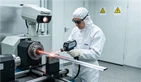
All Level 4 laser devices must bear a clear "danger" warning sign. Level 4 lasers can also damage materials near the laser and ignite combustibles. Eye protection devices are also required when using this level laser, as is the case with Level 3b lasers. And when using higher-power lasers at the same time, special laser-protective glasses and laser-protective clothing must be worn (Figure 1).
2. Environmental requirements for the safe use of laser equipment
The type of laser used in the field of industrial processing is the laser with a safety grade of four. The improper use of this kind of laser will cause great harm to the human body. Therefore, the use environment of industrial laser equipment should do the following safety checks.
2.1 External Environment of the laser device
Before using industrial laser marking, welding, cutting, and cleaning equipment, ensure that all circuit connections are properly connected, all enclosures of the equipment body are covered and all screws are fastened to prevent laser leakage and ensure proper laser power control. At the same time strictly prohibit irrelevant personnel to enter the laser production area.
The operating environment requirements of laser equipment are relatively high, the humidity in the air, the concentration of dust particles can not be too large, can not have too strong vibration interference sources or electromagnetic interference, the use of laser equipment is best in the independent operating room with good ventilation conditions, while ensuring the indoor temperature stability, the best condition is to install constant temperature air conditioning or placed in a constant temperature and humidity dust-free room.
In addition, the indoor operating space within the laser equipment placement area should be kept bright. At the same time, the walls, ceilings, doors, and other non-combustible diffuse reflective materials should be used. The window glass should be shielded by a black curtain.
2.2 Internal Environment of the laser device
When using the above laser equipment, carefully read the list of materials that can be operated with a laser. It is forbidden to use lasers for inflammable, explosive, toxic, and hazardous materials without production protection. When starting the laser, check whether the warning light and alarm are working properly. Remove the workpiece waste slag in time during operation to prevent damage to the laser equipment caused by contamination of the laser head or splashing of the residue. Check whether the beam baffle can block potentially harmful laser beams.
3. Conclusion
Whether it is industrial production or daily life, safety awareness should always be established in the application fields involved in laser; Laser application industry practitioners should have professional professionalism, strengthen the use of laser safety for social publicity, and jointly promote the use of laser safety.
Contact information:
If you have any ideas, feel free to talk to us. No matter where our customers are and what our requirements are, we will follow our goal to provide our customers with high quality, low prices, and the best service.
 Email:info@loshield.com
 Tel:0086-18092277517
 Fax: 86-29-81323155
 Wechat:0086-18092277517


